
Legal films: When cinema goes to court
Luciano Mariani
info@cinemafocus.eu
© 2026 by Luciano
Mariani, licensed under CC
BY-NC-SA 4.0
. Introduction: a genre in its own right?
There is a vast body of films whose plots feature scenes or sequences of varying lengths set in a courtroom: we have termed them ‘legal films/courtroom dramas', but the works to which this term applies are identified in English by a variety of labels, including legal drama, law film, trial film ... The different ways in which this type of film can be described suggests that it is difficult to draw up a profile of them, that is, a set of characteristics that might justify their belonging to a clearly defined cinematic genre (as is the case, for example, with westerns, musicals, thrillers, science fiction films, and so on). One reason for this difficulty in categorisation is the fact that scenes set in a courtroom appear in countless films, which in turn belong to every cinematic genre, from comedy to melodrama, from crime thrillers to war films, precisely because so many stories told on screen involve some sort of legal aspect: the characters in such stories may indeed be involved in events of some civil or criminal significance, which justifies the recourse to ‘justice’ to drive the story forward or bring it to a conclusion. We could, however, indicate the boundaries within which all these films can be considered, on an ideal continuum. At one extreme, there are films set entirely or for the greater part of their running time in a courtroom; at the other extreme, there are films in which the courtroom plays a very marginal or even entirely secondary role. In the latter, the trial may take place, for example, towards the end of the film, as an almost ‘obligatory’ step to conclude a story that has unfolded up to that point in other settings or contexts. To define the scope of our study, we shall therefore consider as ‘legal films' that genre (or sub-genre) of films in which the courtroom sequences are central to the plot, not only because (1) they occupy a considerable portion of the film’s total running time and/or because (2) actions taking place in the courtroom constitute crucial plot developments.
2. Dramatic action inside and outside the courtroom
Even with these limitations, however, there are not many films that take place exclusively inside a courtroom. A famous example is 12 Angry Men, in which the entire story unfolds in the room where the twelve jurors are confined to decide whether the accused is guilty or innocent, with the consequent reconstructions of the facts and their final assessment. This film is therefore a rare example of unity of time, place and action, as if it were a single long take in which the duration of the story and the duration of the film coincide exactly: the viewer enters the room along with the jurors, and leaves when they do, having reached their final verdict.
Twelve angry men (Sidney Lumet, USA 1957)
More often, in legal films, although the action takes place, as we have described, in a courtroom, these sequences alternate with others set outside, yet which involve narrative developments of immediate relevance to what is happening in the courtroom. An equally famous example is Anatomy of a Murder, in which a small-town lawyer (James Stewart) agrees to defend an army lieutenant (Ben Gazzara), accused of killing the man who had raped his wife (Lee Remick). Between hearings, the lawyer meets both the lieutenant and his wife, and gathers a series of ambiguous details that are subsequently reflected in the next hearing (and which leave the audience uncertain about the truth of the facts as reconstructed in court). In this case, as in many others, the scenes outside the courtroom are crucial for understanding both the background and the personalities of the characters involved, but even more significant are the hearings in which facts and characters are put to the test to untangle what is, in fact, an inextricable web of truth and lies.
Anatomy of a murder (Otto Preminger, USA 1959)
A different, yet in some ways similar, case is that of films which, in the narrative’s present, are set in a courtroom, but which make use of flashbacks - that is, the accounts of the accused and witnesses - to reconstruct the past events that form the subject of the trial. In these cases, the flashbacks may even take up lengthy sequences, but, once again, the facts that gradually emerge are interpreted - a crucial element for the plot’s development and the film’s conclusion - still within the courtroom, where the dramatic confrontation between prosecution and defence is underpinned by what is recounted in the flashbacks. One example is a curious western film, Sergeant Rutledge, in which a sergeant (Woody Strode), belonging to a regiment composed solely of black soldiers, is accused of rape and murder. The events are reconstructed entirely through the use of flashbacks (which tell the actual story according to the conventions of the ‘western’ genre, of which director John Ford was one of the leading exponents), whilst the courtroom debate over how to interpret those events forms the ‘framework’ within which the dramatic tension unfolds, handled according to the conventions of the ‘legal film’.
Sergeant Rutledge (John Ford, USA 1960)
The film is also interesting because it demonstrates, on the one hand, how courtroom dramas can unfold in settings and through narratives typical of other film genres, and on the other hand, how complex issues (in this case, racial prejudice) can form an integral part of the themes and meanings conveyed by a film belonging to the genre we are examining. We shall indeed see later on how legal films do not merely depict court proceedings - which, admittedly, form their ‘narrative core’ - but delve into the heart of underlying themes, which amplify and enrich the scope of the ideas and meanings the films themselves aim to convey.
The serious and challenging themes typically addressed in courtroom dramas can, however, be combined with a lighter tone, as evidenced by the existence of films of this type that venture into the seemingly very different genre of comedy. The pairing of Spencer Tracy and Katharine Hepburn remains legendary; in Adam’s Rib, they play husband and wife, both magistrates, yet pitted against one another as prosecutor and defence counsel respectively for a woman (Judy Holliday) accused of murdering her unfaithful husband. The film brilliantly blends comedy and courtroom drama, alternating between domestic scenes and courtroom scenes, in which Hepburn demonstrates all her ‘grit’ in championing her feminist cause. A battle of the sexes, then, but one told in the passionate yet resolutely committed tone of a defence of women in a male-dominated world, as championed in Hepburn’s fiery closing speech (see the video below on the right), which her husband (the prosecutor) barely manages to match.
Adam's rib (George Cukor, USA 1949)
And even science fiction has emerged as a cinematic genre ‘hosting’ a courtroom drama: in Judge Dredd, set in a dystopian New York of 2139, judges seek to enforce the law aboard armoured motorbikes, and the toughest of the bunch is none other than Sylvester Stallone, almost a war machine always ready to intervene (even without worrying about the law...), in a film, adapted from a ‘graphic novel’, which naturally sees the American actor triumph in a story that is more of an adrenaline-fuelled action film.
Judge Dredd (Danny Cannon, USA 1995)
3. The ‘geography’ of the legal film
"In order to qualify as a law film the following characteristic(s) must be present in some shape or form: the geography of law, the language and dress of law, legal personnel and the authority of law. This excludes films where ‘justice’ is enforced outside of any legal framework for example, war films, social dramas and family sagas." (Note 1)
In this quotation, the ‘geography of the law’ is identified as a primary characteristic of a film that can be defined as ‘judicial-procedural’ the 'geography of the law', that is to say, as we have observed in the preceding paragraphs, the setting of the story: not only a physical location (a courtroom), but also the legal language used to communicate, the key characters (such as judges, lawyers, juries...), together with the images and symbols that distinguish them and which have entered the collective imagination as a result of exposure to a large number of films of this type. For example, many courtroom films show, at the beginning or at some point in the narrative, the buildings that house the court: these are generally imposing structures, which in their majesty embody the power of the law’s authority and make a striking impression through the image they present of the legal system as the official guardian of justice. These are buildings that inspire a sense of awe in those who look upon them, because we know that within them, it is not only ceremonial proceedings dictated by precise regulations that society has laid down that take place, but also human stories - often dramatic ones - involving people subjected to a collective judgement based on the opposition between ‘right’ and ‘wrong’, or more broadly between ‘good’ and ‘bad’, between ‘good’ and ‘evil’ – with the equally crucial corollary of the fates that await these people depending on whether they are convicted or acquitted. Often these ‘courthouses’ are adorned with flags, statues and paintings (for example, the classic depiction of the scales) that further emphasise the extraordinary status of these places dedicated to the administration of justice.
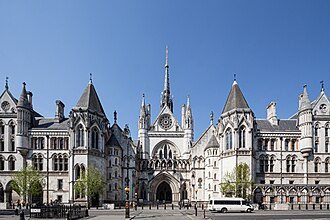
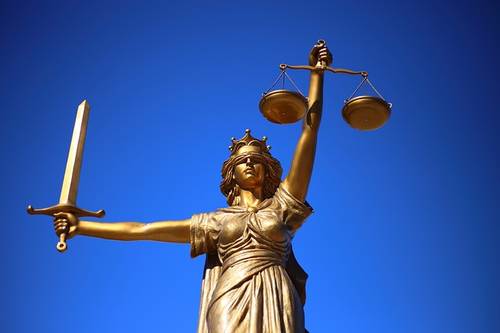
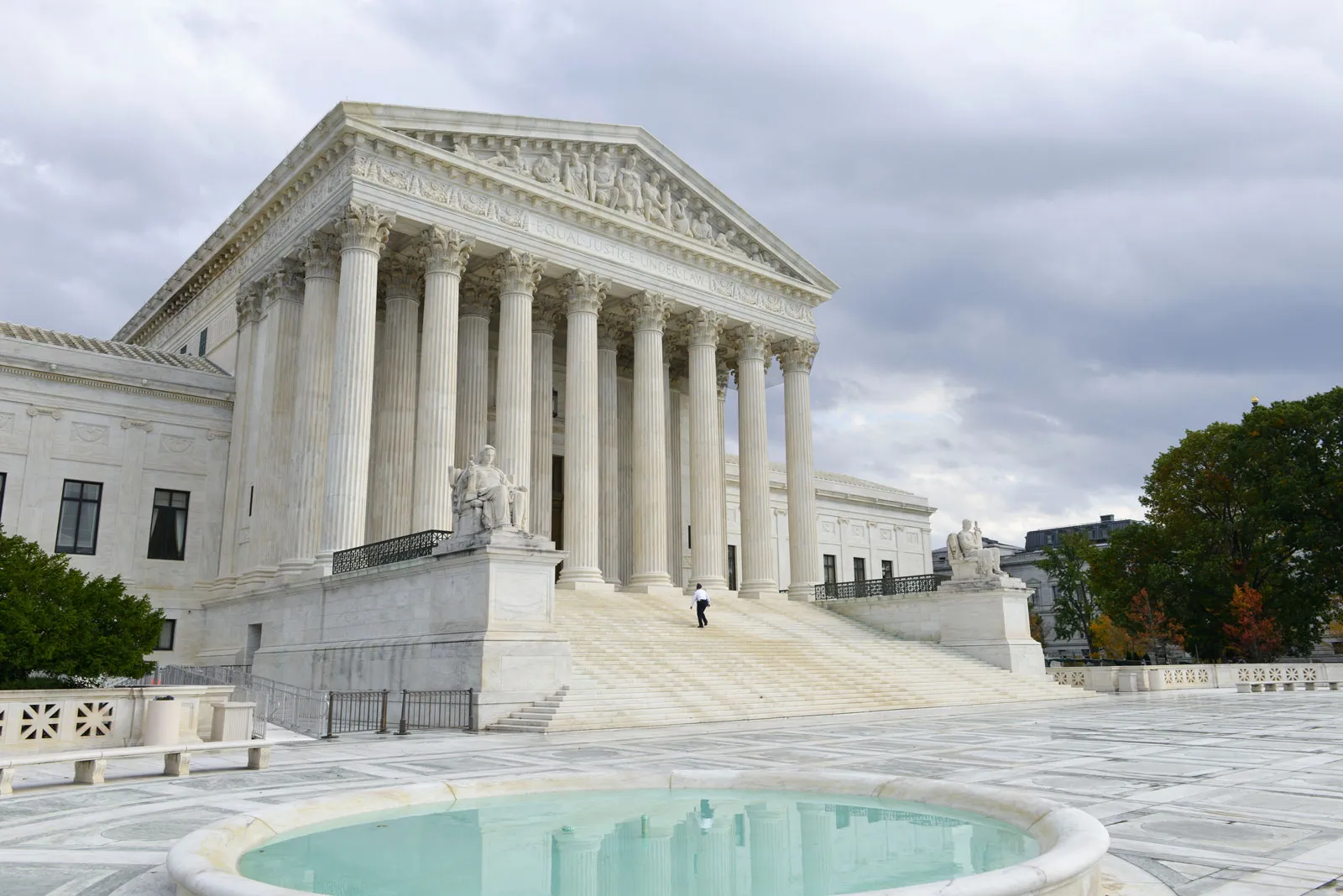
Royal Courts of Justice, London U.S. Supreme Court, Washington D.C.
When we enter a courtroom, new images and symbols continue to make us perceive these places with the same sense of awe. The rigidity of the procedures, the ritualistic formulas, and the very physical arrangement of the furnishings evoke an imagery we have all internalised, as does the positioning of the figures within this setting. At the start of Witness for the prosecution, the procession of judges opening the trial is particularly evocative as it recalls the historical tradition of hearings at the British ‘Crown Court’, with the ritual symbols of a ceremony with an almost religious feel.
Witness for the prosecution (Billy Wilder, USA 1957)
The positioning of the various figures involved in the trial is also usually clearly defined and, despite variations depending on the location and over time, immediately and easily recognisable: for example, the judge is usually seated in a raised position relative to all the other ‘actors’, whilst the jury sits to one side, emphasising, on the one hand, the authority of the law, and on the other, the ‘neutral’ position of those called upon to pass judgement on guilt or innocence ‘in the name of the people’. (The image below refers to the British system; the American system has some different roles and corresponding terms: see the box below.)
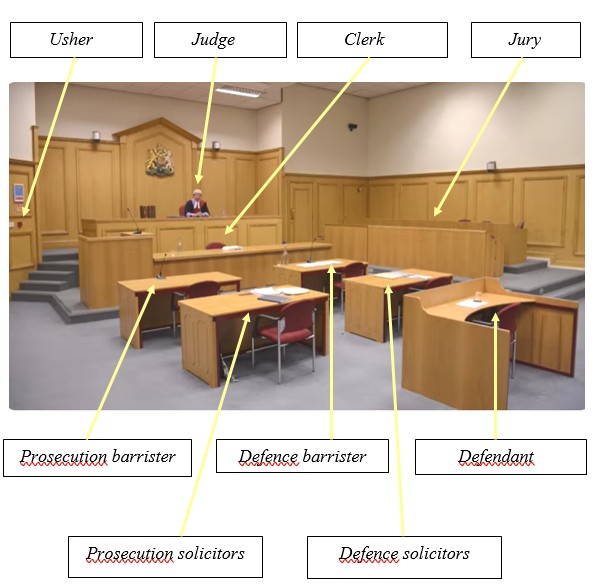 |
The following two videos give a brief outline of how the British and American systems work.
|
The Crown Court in the British system |
The courtroom in the American system |
4. The enduring and undeniable appeal of courtroom dramas
4.1. A genre beloved by audiences
‘Trials are already movie-like to begin with and movies are already trial-like to begin with.’
Carol J. Clover (Note 2)
Courtroom dramas have always been a part of the history of cinema, proving that the elements that characterise them possess an undeniable appeal. If cinema always offers its viewers a “window”, a “mirror”, a “telescope” and/or a “microscope” through which to look out upon a world and the characters who inhabit it, thereby providing the opportunity to observe, in a context of total safety and “impunity”, what might even be considered “highly private”, courtroom dramas fulfil this function in an even more profound way: we witness events that at a certain point take on criminal significance, and the characters are imbued with entirely unique identities and motivations. As in crime films, thrillers and ‘mystery’ films, elements come into play that stimulate our engagement to the highest degree and compel us to find answers to crucial questions, such as: What really happened? Who is responsible for these events? Why did the characters behave in that particular way? Do they deserve punishment?, whilst at the same time appealing to our innate desire to discover the ‘truth’, to determine whether a character is guilty or innocent, and to ensure that ‘justice is done’ - all aspects that engage us both cognitively and emotionally. It is no surprise, then, that the dynamics within a courtroom, and the conclusions reached there, serve as a powerful dramatic device in fulfilling one of cinema’s fundamental functions: that of engaging viewers and immersing them fully in the story being told.
"Trials compel the general public as well, drawing us in because they offer access to the tensions and wounds of the private sphere - the transgressions of social norms, the rule breakings, passions, desires, and alibis - all framed through the camera obscura of memory and human subjectivity. As we follow trials, we are put in the deliciously contradictory position of the ethical peeping tom, one who can feel the thrill of subversive watching from a sanctioned and safe position ... Trial films concentrate on the most dramatic elements of trials: testimony and crossexamination, courtroom strategy, surprise revelation, and uncertainty about the truth and its relationship to justice. In doing so, they intensify spectatorial expectations about the kinds of pleasures we associate with courtroom contest, deliberation, and judgment and, more generally, what trials can ultimately deliver." (Note 3)But courtroom dramas have an extra edge: they invite viewers not only to ‘watch’, but also to see what sometimes remains hidden or should not even be seen (thus fulfilling that role of spectator-voyeur that directors such as Hitchcock relied on to manipulate the audience’s emotions): these films add equally powerful auditory stimuli to the visual ones, to an extent that does not carry the same weight in other film genres. In a courtroom, in fact, what one sees matters, but so does - and perhaps even more so - what one hears: this setting, in fact, is the realm of the spoken word, uttered aloud by lawyers, judges and witnesses, who, through the spoken word, have the task of recounting, describing and assessing facts and circumstances, as well as outlining the identities of those involved (the accused, but also witnesses for the prosecution or the defence). The courtroom is the institutionally designated venue for debate, confrontation and dialectic - even when it is bitter and dramatically gripping - which reaches its climax during the closing arguments of the prosecution and the defence, when every word counts and the ability to use them convincingly becomes the focal point of the decisions the jury will make. Unforgettable, for example, is the final courtroom scene in Compulsion, in which two young men from good families are accused of the murder of a young boy, committed without provocation simply for the sake of committing the perfect crime: in a memorable closing speech, the defence lawyer (Orson Welles, who won an award at the Cannes Film Festival alongside the two young actors) manages to spare them the death penalty. This is an exemplary film in relation to the discussion on the ‘courtroom genre’ referred to in the Introduction above: the courtroom scenes take place only in the final part of the film, but their dramatic power (and Orson Welles’ magnificent performance) fully satisfy the criteria we have set to define and delimit the category of these films.
Compulsion (Richard Fleischer, USA 1959) - Full film; the final statement begins at 1:28:42
It is hard not to be drawn in by this powerful display of the power of words; but then again, courtroom dramas, as has been said, draw viewers - subtly yet powerfully - into the stories they tell and the characters they portray, to the extent that they find themselves effectively identifying with the jury - a ‘comfortable’ position because it allows them to reconstruct, alongside the jurors, what has (or may have) happened and to form an opinion on the innocence or guilt of the accused, without, at the same time, being obliged to assume the responsibility that, in films as in reality, is imposed on the jury:
"Film audiences experience the immersions of a
juror - the glimpse into hidden worlds, the pleasures of knitting together
evidence into a story, the frisson of antagonistic performances - without the
jury’s ultimate responsibility to decide the outcome of a case." (Note 4)
In a few rare (and for that reason all the more interesting) cases, this quasi-identification of the audience with the jury is taken to the extreme: in None shall escape, the audience, as the title suggests, cannot shirk the responsibility of passing a final judgement themselves. The film, shot in 1944 - at a time when the outcome of the war was still unknown - tells the story of a court called upon to judge a Nazi criminal - effectively foreshadowing the real Nuremberg trials of Nazi leaders (1945–1946), which will be recounted in Judgment at Nuremberg (Staney Kramer, USA 1961). In None shall escape, after various witnesses have recounted, each from their own perspective, the story of the Nazi officer, the presiding judge (see 1:25:01 in the video below) does not pass any judgement, but asks the audience to judge the defendant (who pleads ‘not guilty’) for themselves ... an extreme example of total audience involvement, with the audience called upon to take on the role of the jury in the very subject matter of a courtroom drama.
None shall escape (André de Toth, Usa 1944) - Full film
Such films ... situate audiences in the seats of jurors, shaping and reshaping our sense of the unstable ties between procedure and fairness, evidence and truth, and responsibility and judgment. The pleasures of the genre flow from the very process of watching, weighing, and testing characters, evidence, process, and outcome. Such films create a theater of justice and injustice; and to the extent that they interpellate us successfully as juror-spectators, they create conditions of possibility for our continuing attachment (however ambivalent) to the project of law." (Note 5)4.2. A genre beloved by directors and screenwriters
Given the fascination that courtroom dramas have always held for audiences, it is hardly surprising that, on the production side too, producers, directors and screenwriters have also succumbed to this fascination and, even more so, to the prospects of commercial success (if not always critical acclaim) that such films could guarantee. We have already mentioned that audiences, just like readers of crime novels, are generally interested not only in solving a mystery (Who did it, how did they do it and why did they do it?), but also in its deeper implications, which concern ethical and social issues: the mystery to be solved is not a purely private matter involving two or more people, but, due to its legal significance, necessarily implies that the public (of which viewers are obviously a part) and its representatives (prosecutors, judges, lawyers) are called upon to restore an order compromised by a crime, through the establishment of the truth and the conviction or acquittal of the accused. Thus, courtroom dramas appeal to a widespread desire for justice and to see the public good protected from the dangers and risks arising from the breaking of the law.
The desire for justice and the need to see the ethical order that must characterise the life of a society upheld must be able to be realised on screen (even if not always in real life) in a fitting conclusion, a happy ending which, in such cases, does not consist of a happy resolution to the problems faced by the characters (such as a couple getting back together in a comedy or romantic film, or victory over enemies - albeit at a heavy cost - in a war film). In courtroom dramas, the ending deemed ‘appropriate’ to satisfy the audience does not necessarily coincide with the happiness of the accused protagonists on trial (who, indeed, may have to suffer the consequences of a possible conviction), but with the restoration of a higher social order, which goes beyond the private sphere because it concerns the key principles of a society that wishes to be founded on justice, that is, on the distinction between ‘good’ and ‘evil’. between truth and falsehood, between chaos and order – even if these dividing lines are not always clear-cut, and even if the ‘truth’ established by a verdict may not coincide with the ‘absolute truth’ in which we are all interested but which is often difficult, if not impossible, to establish.
But even in courtroom dramas, the conclusion of the film (its ‘appropriate’ if not always ‘happy’ ending for the characters) must be perceived as the necessary outcome of a series of events (from the crime to the verdict) that constitute the web of facts from which the narrated story is woven. It is precisely the legally relevant nature of these facts that makes them interesting and engaging, as if the crime were to generate the plot twists necessary to captivate
the audience’s engagement. The events leading up to (and often occurring alongside) the courtroom scenes are thus imbued with a highly dramatic tension, echoing the observation made earlier that “Trials are, in themselves, akin to films, and films are, in themselves, akin to trials.” These are considerations that make a story with a ‘trial-like’ element so appealing to those who must bring it to the screen, starting with the producers and, of course, involving screenwriters and directors. As we shall see later, however, the more strictly ‘trial-like’ element must be based on a narrative development, ‘prior’ to the trial, that is equally gripping, and on a selection of issues at stake that capture the audience’s interest (such as, for example, a heinous crime that could result in a death sentence).
"The courtroom has obvious attributes that have been utilised by playwrights and more recently film makers. However, a law film is much more than a courtroom drama and it may be difficult, although not impossible, to sustain a complete film within the confines of the courtroom. So why the law? First, the public have a fascination with the law. This is evidenced on a number of fronts and has increased with lawyers becoming well known figures via the media and the law being a central issue in the newspapers on the television. Secondly, in much the same way that courtroom proceedings are dramatic, the law is a perfect vehicle for all sorts of stories ... the law has central characteristics and contradictions that make it such a viable vehicle for storytelling: ‘The essence of the law movie is that it offers the writer and director a chance to explore the potential for the clash of two opposing forces which may be portrayed as good/evil, right/wrong, moral/immoral’ (Greenfield & Osborn 1995, p 112). That said, it is important to note that not all legal proceedings and issues have a natural dramatic content - most films tend to concentrate upon the criminal arena, often because this may focused on a life or death issue ... However, not all about the law is dramatic or interesting and there are certain aspects of the law that will not normally be selected for cinematic portrayal ... There needs to be a dramatic element, and this can be produced through a serious crime that draws in the viewer and captures their imagination." (Note 6)5. ‘Law’ and ‘justice’ in legal films
Whilst the underlying ethical and social theme in this genre of film is the fulfilment of justice through the application of the law, these two key concepts do not always interact in a balanced and ‘correct’ manner from a purely theoretical point of view; in fact, sometimes, in films as in reality, justice is not fully served, the law may not be applied according to clear and absolute criteria or may even be manipulated, and establishing the ‘truth’ can prove difficult, if not impossible. The law, in other words, can fail or prove insufficient to ‘do justice’ (or to prevent injustice). These elements, too, often form part of the themes addressed in a courtroom drama, and it is precisely their relevance to the stories told (and to the ‘appropriate’ conclusion mentioned in the previous section) that constitutes a further reason for the audience’s interest and engagement. The potential discrepancy between law and justice may indeed form the central theme of a film, whilst simultaneously heightening its dramatic power. An illuminating example of this tension (which is not merely theoretical but is imbued with dramatic weight) is provided by To Kill a Mockingbird, in which a progressive lawyer, Atticus Finch (Gregory Peck, who won an Oscar for Best Actor), finds himself having to defend a black man, Tom Robinson (Brock Peters), against the shameful accusation by an alcoholic white farmer, Bob Ewell (James Anderson), of raping his daughter – even though Tom maintains his innocence. Atticus manages to prevent the defendant from being lynched by a group of racist townspeople and, during the trial, succeeds in proving the charge to be groundless (see his closing speech in the video below). However, the jury still returns a guilty verdict. Rather than await the appeal, Tom attempts to escape whilst being transferred to prison and is shot dead by a prison guard. Bob, the man truly responsible for the violence against his daughter, aware that he has been exposed by Finch, swears revenge and attacks Atticus’s children as they walk home through the woods; however, a stranger intervenes, defending them by killing the attacker. The mysterious man turns out to be Boo, a man considered ‘mad’ by his neighbours, who had grown fond of the children even though he had never met them directly. The sheriff, realising that Boo would be unable to cope with the consequences of his actions, decides to rule Bob’s death an accident - specifically, the result of him accidentally falling onto his own knife.
To kill a mockingbird (Robert Mulligan, USA 1963)
The film touches on a number of issues that are highly relevant to the relationship between law and justice. First and foremost, Atticus’s closing speech focuses on the irrelevance or even the lack of evidence against Tom – which does not prevent Tom from being convicted nonetheless, raising the issue of how the establishment of the truth through the support (or refutation) of concrete facts cannot be taken for granted, but is subject to the interpretations of those (the jury) who are supposed to use them to apply the law. It is clear that these interpretations are tainted by the racist tendencies that permeate this society, which in fact does not hesitate to set aside the law to take justice into its own hands (the attempted lynching of Tom, his killing by a prison guard, that is, another representative of the ‘law’). Violence, that is, the rejection of the principles of civilised and democratic coexistence, is in fact what underpins a system poisoned by racism. But even the sheriff’s decision (note that he is a figure on the periphery of the judicial system in the strict sense) 'bends' the law to his own, albeit reasonable and commendable, ends, turning a murder into a mere accident (which raises the question of whether the law can be “right” or “wrong”, and whether it is right and acceptable to break it when it seems incapable of preventing and combating injustice). Overall, therefore, the law fails to ensure justice, the truth is difficult to prove and, above all, to make one accept it in the face of prejudice, and one senses that, when ethical values are called into question, it is still humanity and its tangible reality that serve to stem, at least in part, the tide of injustice. As we have already noted, in courtroom dramas the tension between justice and injustice is also fuelled by other moral elements, such as racism in this case – proof that, as we shall see later, this type of film is often permeated by ethical issues and far-reaching ideologies.
To conclude this section, we note that in courtroom dramas there is an underlying yet no less significant conflict between ‘natural’ law or justice – an ethical principle inherent to the human condition – and laws, which are also human in origin but established within a system; a conflict between two principles that do not always coincide, and of which the stories told in court cases provide illuminating examples. The conflict also manifests itself between the ‘ideal’ of justice continually pursued and the ‘reality’ of a legal system that struggles to fulfil this absolute desire. The efforts of the characters in the courtroom, particularly those of a defence lawyer ‘committed’ to resolving this fundamental dilemma (often against a much less sensitive and conscientious colleague on the prosecution side), are aimed at ‘bridging the gap’ between ‘natural law’ and the ‘law of men’, bringing this gap to a final resolution, which also means restoring a state of balance to a situation that had lost that balance due to a criminal act. Often this ‘return to the initial balance’ at the end of a laborious and painful process is also reflected outside the courtroom, in the private lives of the protagonists. For example, in The Paradine Case, the defence lawyer (Gregory Peck) representing a beautiful woman accused of murder (Alida Valli) falls under the spell of his client, causing his own marriage to fall into crisis. The resolution of the case thus represents a twofold return to equilibrium: the ‘public’ equilibrium of the final verdict and the ‘private’ equilibrium of the lawyer, who can return to the tranquillity of his marital home.
|
The Paradine case (Alfred Hitchcock, USA 1947) |
6. The dominance of American imagery
"If ideology is the myth people live by, then the images of trial films constitute a rich and globally powerful source of ideology about the nature of criminal justice processes." (Note 8)
The cinematic portrayal of the trial, and, more generally, of the legal system, has always been dominated by examples provided in US films, which, thanks to what was for a long time the world’s most flourishing and productive cultural industry, have exported their model everywhere, fostering similar images even in countries with legal systems different from the American one. Audiences around the world have thus formed expectations regarding the workings of justice based on the models continually provided by Hollywood films of the courtroom genre, regardless of their own national legal systems and cultures. The portrayals offered by this filmography have thus become so popular and accepted that the US legal system is perceived as the only possible one, or at least the standard by which to interpret and evaluate the themes, settings and characters of this cinematic genre. This popular culture, which is the sum of the beliefs and
attitudes that an audience has developed towards the law and justice, based on the portrayals provided by the mass media such as cinema, play a decisive role in shaping the ways in which viewers approach the issues raised by films, endowing the films themselves with significance that extends far beyond the success of any single film:"Popular culture is the raw material out of which people extract information and construct opinions about how the law works and what lawyers do. Courtroom movies should be taken seriously because they reflect what people already believe (or at least what filmmakers think they believe). Even more important, these films reinforce and have the potential to change those beliefs. For all these reasons, it’s well worth reflecting on the messages that courtroom movies send to viewers." (Note 9)
All this has significant implications for the ways in which these films stimulate public interest and engagement. Unlike legal systems in which the prosecutor is responsible for gathering all evidence relevant to the trial, including any that may favour the defendant, in the American system the prosecution and defence each present, on their own behalf, their own version of the facts and how they believe these should be interpreted and assessed. This leads to a very intense confrontation in the courtroom, where the proceedings can easily turn into an open conflict, extending far beyond the events under discussion, between two protagonists who soon become outright adversaries, heightening the contrast between opposing visions of ‘good’ and ‘evil’, of ‘truth’ and ‘falsehood’. The atmosphere in these courtrooms is thus immediately charged with dramatic intensity, creating a battleground that is highly conducive to the audience’s emotional engagement.
For example, Philadelphia tells the story of a lawsuit brought by a young, brilliant gay lawyer, Andrew (Tom Hanks, winner of the Oscar for Best Actor), against the prestigious law firm for which he works, which formally dismissed him for professional misconduct, but in reality because of his sexual orientation, compounded by the fact that he has AIDS. One of his black colleagues, Joe (Denzel Washington), after much initial hesitation, decides to take up the defence of Andrew’s rights, which have been so blatantly violated. After a bird’s-eye view of the courtroom, dominated by an imposing statue (in keeping with the ‘classic’ ways of introducing the legal setting that we have already considered in Section 3), in his opening statement at the trial, Joe clearly articulates the ‘philosophy’ of the American legal system: addressing the jury, he states emphatically: “Forget everything you’ve seen on television and in the cinema. There will be no last-minute surprises like tearful confessions. You will be presented with a simple fact – Andrew Beckett was dismissed. You will hear two accounts of why he was dismissed: ours and theirs. It is your task to sift through the layers of truth until you decide for yourselves which version rings truer.” The truth of the trial is immediately framed as a conflict between two opposing truths – and the jury (and the public) are invited to carefully compare the two versions. This builds the dramatic tension that will run through the entire trial. The film, however, as in other cases already mentioned and others we shall see, is also, and perhaps above all, a passionate, ‘politically correct’ battle against prejudice - ranging from that concerning sexual orientation and AIDS to racial discrimination and, more generally, cultural differences - with which the jury (and the audience) are called upon to grapple.
Philadelphia (Jonathan Demme, USA 1993)
Another significant difference between the American and European legal systems has a direct impact on the way dramatic tension is built up during a trial. The American system relies primarily on the consideration of past ‘cases’, which are identified and used as points of reference in relation to the specific case in question, whereas in other systems, such as those in Europe, written codes predominate. The American system therefore offers, compared to other systems, the possibility of making concrete references to past cases to identify similarities and differences, which implies greater concreteness and constant references to previous judgements and the stories associated with them. Hence also the possibility of last-minute ‘surprises’ (the very ones that the Philadelphia lawyer Joe deplored), which are difficult if not impossible in other systems, more codified in written codes and in which conflicts, as well as over evidence and testimony, centre on the interpretations to be given to those codes. Not forgetting, as we have already mentioned, that at trial the prosecution and defence arrive with evidence and testimony gathered beforehand and gradually ‘revealed’ during the proceedings. The gathering of evidence and testimony is often delegated to private investigators working with one side or the other, and the figure of the ‘detective’ has thus become one of the key characters in this genre of film.
We must also bear in mind that district attorneys in the American system are elected officials, and that political interference therefore often plays a significant role – conflicts between prosecutors and defence lawyers thus take on an additional dimension, bringing into play not only the abilities of the individuals involved but also, in many cases, their affiliation with different political positions and the repercussions on relations between the prosecution and the defence.
A final factor contributing to the high drama of these trials is the fact that the death penalty is in force in many US states; even when merely mentioned, it greatly heightens the dramatic potential of the courtroom debate. The audience knows that a life is at stake, and any doubts regarding the defendant’s innocence or guilt, or even the suspicion that a miscarriage of justice might occur leading to an unjust conviction, are all key strengths of this courtroom drama. One example is A Place in the Sun, in which George (Montgomery Clift), an ambitious young man courting an heiress (Elizabeth Taylor), plans to kill a young factory worker (Shelley Winters) who has become pregnant by him, during a boat trip. However, he lacks the courage to do so, even though the woman dies in an accident. George is nevertheless charged and sentenced to death, and ultimately accepts his sentence. In cases such as this, the film seems to oscillate between a human understanding of the guilty parties and their equallyjustified condemnation, leaving this dramatic tension to the audience, who are thus drawn in as much by the human story as by the need to ensure that justice is done, yet with an underlying ambiguity that persists right to the end.
A place in the sun (George Stevens, USA 1951)
An even more explicit case in addressing the issue of the death penalty is told in I want to live!, in which a young woman (Susan Hayward) is accused and sentenced to death for a crime she did not commit. Here too, the audience is called upon to take a stand (and in effect to take sides) in support of the woman, who is clearly a victim of public prejudice and the bias of a press openly hostile to her (although a journalist (Simon Oakland), initially opposed to her, later attempted to save her at the last minute). Once again, the courtroom drama genre is used to explore broader reflections on justice, its ambiguities, and the role of society in determining and influencing the fair application of the law.
I want to live! (Robert Wise, USA 1958)
"Legal dramas follow particular conventions that are more or less specific to American culture; they are prone to the perpetuation of stereotypes, whether the centre of interest be the miraculous comeback of a burnt-out lawyer, the abuse of the legal system to secure the acquittal of a guilty client, a prosecutor’s fight for justice, or the unexpected, emotional confession of a conscience-stricken person on the witness stand. The dialectical approach to judicial questions and the theatricality inherent in the gradual resolution of the conflict can be regarded as minimum requirements for the classification of legal narratives, besides the locale of the courtroom." (Note 10)
7. Inaccurate portrayals
Courtroom dramas are often based, as we have just seen, on established conventions and depictions of legal systems that have more to do with what appeals to and satisfies the audience than with a realistic view of how these systems actually function in reality. ‘Popular culture’, in fact, has internalised rather stereotypical representations which, in many cases, are driven more by audience expectations and the creation of interesting and engaging stories than by the accuracy and precision of the narratives. Taking the US legal system as an example once again, the fact is ignored that the vast majority of cases, both civil and criminal, are settled out of court, and thus without resorting to a trial in a courtroom (Note 11); that there are in fact more civil cases than criminal ones; and that, in reality, recourse to a jury trial is, in a sense, a last resort, far rarer than is shown in films.
On top of all this, court proceedings are often depicted without adhering to the actual rules that govern such settings. The same applies to the portrayal of key figures involved in a trial: lawyers, for example, are often portrayed in unrealistic but narratively more compelling terms, as zealous individuals who will stop at nothing to defend their client’s case or as people torn by the moral dilemma of defending a defendant they know to be guilty; just as prosecutors can be portrayed as people who resort to morally questionable means in order to secure a victory – forgetting in all these cases that the prosecution and defence work (or at least, should work) impartially to ensure that the defendants receive a fair trial regardless of the offence of which they are accused. And the same applies to judges and juries, described as entities subject to various influences and intentions that may undermine the role the law assigns them in proceedings.
In fact, as we have already noted, courtroom films tend to emphasise the new revelations that emerge during cross-examinations and, in particular, the final surprises, in which a witness might provide information capable of overturning the narrative that has developed up to that point during the trial – all conventions that ensure the film’s ‘spectacular appeal’ through a dramatic tension that is renewed several times throughout the story.
"Courtroom films survive only because they can depart from everyday legal reality. They do not portray the normal treatment of cases but the exceptional cases, and in these portrayals the law is often insufficiently (if not distortedly) described and the situation is resolved thanks only to an unusual person employing extra-legal methods." (Note 12)
8. The key figures in the courtroom
8.1. Defence lawyers
The defence lawyer has always occupied a prominent place amongst the characters in courtroom dramas, primarily because of her/his position – even more so than that of the prosecutor – as the point of contact between the defendant and the justice system, and thus between the imbalance caused by the crime committed and the restoration of a new balance through a final judgement that satisfies society’s demands for justice. However, beyond the ‘official’ role with which they are entrusted, defence lawyers often find themselves at the centre of these films for many other reasons, relating both to their profession and to their private lives. One of these is the potential discrepancy between professional ethics and the ‘financial’ aspects, which constitute an often lucrative side of their career. But the figures of lawyers are also often portrayed as people torn between the rules of the law and the means that can be used, within a trial, to further their own ends – means that may lie on a dubious, narrow and dangerous boundary line between the need to defend the law as an institution and the urgency of also having to go ‘beyond the law’ to achieve justice. Yet these portrayals also include stories of complex personalities, sometimes turbulent or in the throes of an identity crisis, themselves victims of their own weaknesses. On the other hand, however, in many films, especially ialn ‘classic’ Hollywood, lawyers are portrayed as people dedicated to their work, if not outright heroic and even legendary figures in their constant struggle, not only to save the (allegedly) innocent, but also, and perhaps above all, to ensure a fair trial and the ‘triumph of justice’.
The need to stand by the client/defendant, regardless of the prosecution’s position (often politicised, if not downright biased), and regardless too of the verdict of innocence or guilt - which is the responsibility of the judge and/or the jury - constitutes a source of dramatic tension. This role can at times take the form of a veritable battle waged by an idealistic and almost ‘charismatic’ lawyer to spare his client an unjust sentence. A famous example of this is one of John Ford’s masterpieces, Young Mr. Lincoln, which depicts the early life of the man who would become one of America’s most famous presidents, Abe Lincoln (magnificently portrayed by Henry Fonda). The film aims precisely to highlight certain essential traits of the young Lincoln (including his eloquence as a lawyer and his ability to listen and make himself heard even by the humblest of people), in a way foreshadowing and explaining the bright future that awaits him. In the film, Lincoln finds himself defending two young men accused of murder: first, he manages to prevent their lynching (see the video below at 31:54), speaking passionately to an angry and vengeful crowd; then, during the trial (from 57:27), he will prove his innocence.
Young Mr. Lincoln (John Ford, USA 1939)
In other cases, it is the lawyer himself who is called upon to question his own positions, as we have seen in the case of the black lawyer in Philadelphia, who evolves from skepticism and initial prejudice to a figure of idealism and open-mindedness. In the same vein, in The Verdict, a successful lawyer now prone to drinking, Frank (Paul Newman) will regain his dignity just returning almost reluctantly to work to defend a woman who ended up in a coma after anesthesia. He will have to fight against his colleague, who, determined to defend the category of doctors and, even more, the prestige of the Catholic hospital where the event occurred, does not hesitate to intimidate witnesses and to put pressure on a pusillanimous judge. The image of the lawyer is here far from the splendor of Young Mr. Lincoln, and the film focuses, more than on the typical dynamics of the courtroom, on the figure of a man who fell almost into disgrace, but who, once back in his professional element, redeems himself with a final plea in which he defends with conviction civil rights from the threats of a corrupt world both inside and outside the courtroom.
The verdict (Sidney Lumet, USA 1982) - The closing statement
One can even get to the borderline case where the lawyer's almost unconditional trust in his client turns out to be a trap, leaving the lawyer helpless in the face of the law that he helped not to enforce. In Primal fear, a brilliant, confident and unscrupulous lawyer (Richard Gere) agrees to defend a boy (Edward Norton) accused of killing the archbishop of Chicago. Convinced of his innocence, he fights hard in the courtroom against the prosecution, embodied by a female magistrate (Laura Linney), his former colleague and lover. He manages to get the accused acquitted, but, in the final scene (Attention: spoiler) he will have a bitter surprise: what had presented himself as a man of law and success is thus forced to review all his principles. The film gives another portrait of problematic lawyers, ambitious but also ready to compromise, confident but all in all likely to remain naive victims of dynamics that they seem only on the surface able to control.
In many films of recent decades, therefore, the figure of the lawyer is undermined: in place of the "classic" image, which often made the defense attorney an even idealized figure in his passionate defense of justice and the law, a much more ambiguous one emerges, one whose crises and weaknesses are highlighted. Ambitious but sometimes incompetent, ethically uncertain if not downright dishonest, bolstered by their dubious charisma rather than their professional preparation and expertise, shrewd and/or lucky in their victories, these ambiguities often concern the entire legal system of which they are a part, which has lost the aura of dignity and uncompromising legality to make way for an ambiguous world, uncertain of its very foundations, and therefore subject to the risks and dangers of legal injustice.
|
The firm (Sydney Pollack, USA 1993) |
Also based on Grisham's novel, John Grisham's The Rainmaker features a young lawyer, Rudy (Matt Damon), fresh out of college. As he works his way up the legal ladder, he is soon forced to confront the harsh reality, where his fellow lawyers find themselves having to compromise and resort to dubious, if not entirely illegal, means to protect their clients and both earn money and advance their careers. Conflict erupts once again between law firms and the individual, who is forced to make difficult choices but ultimately reaffirms, even at the cost of taking risks and jeopardizing his career, his professional dignity and his dedication to legality. Rudy will therefore agree to defend a woman who has killed her abusive husband and, above all, will defend the rights of a young man with leukemia against the cynicism of a powerful insurance company. The film is a powerful and clear denunciation of a corrupt system that, beneath the surface of formal legality, involves individuals, but even more so organizations and institutions, and the defense of just causes against the blackmail of profit. In the video below, Rudy briefly recounts his decision to become a lawyer and his admiration for the lawyers of the 1950s and 1960s who were determined to defend civil rights.
John Grisham's The rainmaker (Francis Ford Coppola, USA 1997)
8.2. Prosecuting attorneys
While defense attorneys are, in most cases, portrayed as positive individuals, dedicated both to their clients' interests and to ensuring a fair trial and, therefore, the establishment of truth as a condition of "just" legality, prosecuting attorneys are more often seen as those who, representing the law, are dedicated to accumulating as much evidence as possible against the accused - excluding, however, as mentioned in relation to the American legal system, any testimony that might be in their favour. From the very beginning of trials, when the judge invites them to present their opening arguments, these lawyers adopt a decidedly assertive, if not aggressive, stance, with the intent of immediately engaging the jury to take their side. Obviously, more or less the same applies to defense attorneys, but the prosecution often immediately presents itself as decidedly biased against the accused. But there is one factor that heavily influences the role of the prosecuting attorney: in the American legal system, the office of district attorney is elective, and many courtroom films depict these attorneys campaigning for their appointment. Because public opinion is highly sensitive to what is perceived as the affirmation of legality (through the punishment of those convicted of crimes), these attorneys must take this factor into account in their conduct in court: sometimes the conviction of the alleged perpetrator becomes a reason to reinforce their image as guardians of the law, and therefore worthy of the popular vote. This situation adds dramatic intensity to the encounter/confrontation with the defense, and emphasizes the role and commitment of the opposing party, who is not subject to such political constraints.
One of Clint Eastwood's most recent films, Juror #2, exemplifies this situation, as well as providing a very clear example of the proceedings and dynamics that unfold in a courtroom. A man is accused of killing his partner after a violent argument, and the prosecuting attorney, Faith (Toni Collette), is determined to have him convicted based on little evidence (we also learn that the investigation was rather superficial). But the story's interest heats up when, through brief flashbacks, we are shown how one of the members of the jury (Juror No. 2), Justin (Nicholas Hoult), a former alcoholic, actually ran over the woman and fled. From this moment on, the drama unfolds into two parallel stories: on the one hand, Justin is about to become a father and, in anticipation of this important event, is reluctant to divulge his guilt by accusing himself, but, on the other hand, he is aware that an innocent man could be convicted in his place. During the jury deliberation, he attempts to sow doubts about the defendant's innocence, thus bringing his fellow jurors, who were initially determined to convict, to at least a reasonable doubt (which is the formula with which the jury could reach a "not guilty" verdict). On the other hand, however, the film also focuses on the character of the prosecuting attorney, whom we see actively engaged in the election campaign to win the district attorney's position. Indeed, the defendant is sentenced to 30 years in prison, and Faith is elected prosecutor. However, although initially absolutely certain of her case, Faith is gradually assailed by doubts, which lead her to shift her attention to Justin, who now seems to be trying to erase the past to focus only on his family... But the final scene shows Justin opening the front door and finding Faith standing before him. Their eyes lock - and on this image the film ends. So in this case the conflicts develop largely outside the courtroom, and stage the strong moral doubts that involve, in addition to Juror No. 2, the prosecuting attorney, in this case a more multifaceted figure than the rather stereotypical images offered by many courtroom films.

Juror #2 (Clint Eastwood 2024)
8.3. Private detectives
Investigators, or detectives, are figures that frequently appear in courtroom dramas, especially given the aforementioned fact that in the American system, both the prosecution and the defense must gather as much evidence as possible to present in court, in a heated and sometimes violent cross-examination. This pushes the films to "escape" the courtroom and venture outside, into the society of which the legal system is also a part, adding interest and suspense as new clues are gradually uncovered - and "hybridizing," so to speak, the courtroom drama with aspects and elements more generally found in crime films or thrillers. These investigators may serve the prosecution, as in the case of police detectives, or collaborate with the defense. The result is that the roles of these various figures sometimes overlap (most often in the case of the defense attorney, often a friend as well as a colleague of the detective), thus enriching the trial dynamics with the collaboration necessary to gather evidence and testimony. The close relationship between lawyer and detective was powerfully illustrated in television series from the 1950s and 1960s, primarily in the Perry Mason series, featuring the lawyer whose work depends closely on his ongoing collaboration with his friend, private investigator Paul Drake (though the roles of his secretary Della Street and the district attorney, who is virtually always on the losing end, are not to be underestimated). The private investigator occupies a unique position, caught between the protection of citizens guaranteed by law (which the law sometimes struggles to ensure) and the interface with the political and economic interests that nevertheless shape legal practice. And often, put to the test in a harsh social context, the detective plays a crucial role as an individual who, on the one hand, defends the interests of justice, but on the other must deal with the constant conflict between "good" and "evil," where "evil," once recognized, must be confronted, if necessary, even with violence.
The most emblematic figures of private investigators, however, are those in which they are protagonists, in films that often do not explicitly belong to the judicial-procedural genre but stray into other genres, particularly noir and neo-noir, as in Chinatown, where detective J.J. Gittes (Jack Nicholson), hired by a woman (Faye Dunaway) to gather evidence of her husband's infidelity, actually finds himself involved in plots far more complex than a simple marital problem, himself eventually becoming the victim of high-level conspiracies.
Chinatown (Roman Polanski, USA 1974)
8.4. The jury
"Sympathy and animosity
are reflected in the faces and body language of movie jurors. Even a juror who
remains motionless and with a poker face provokes the viewer to take one side or
the other. The facial expressions and gestures of the jurors serve to comment on
events in the courtroom and therefore create a meta-level parallel to the actual
level of what is going on." (Note 14)
Juries feature prominently in most courtroom dramas, although, as we have already noted, in reality only a minority of criminal cases actually go to trial, and a jury isn't always present. But in this genre of film, the jury represents a crucial element in the dynamics of the trial, even though it generally remains a "passive" entity with respect to what happens in the courtroom, a constant target of the observations and arguments of both the prosecution and the defense. In addition, viewers are often led to identify with the jury members, and are thus called upon to act as decision-makers with respect to everything said during the proceedings.
"The paradox of the jury is that it represents the community version of law’s genesis and yet is almost entirely passive in film. The spectators of the film are the jury. As Hambley (1992, p 173) notes: ‘In most courtroom dramas, the jury is just another audience, sitting quietly in the corner of the courtroom; the jury exists in these movies simply because legal accuracy requires there be a jury during a trial.’ As indicated a favoured shot of the camera is over the shoulder of the jury so that counsel addresses both camera and jury simultaneously." (Note 15)Few films, however, introduce us to the "jury chamber" where jurors gather, literally segregated from the outside world, to decide the verdict (guilty or not guilty). Twelve angry men, which we mentioned at the beginning of this paper, is probably one of the very few films to date that takes place almost exclusively in the jury chamber, confronting us with the complex personal and social dynamics that fuel debate within this group of people. Indeed, the relationships that develop between jurors - particularly when, as in the case just mentioned, all but one are from the outset completely convinced of the defendant's guilt, and the sole juror favoring innocence tries to convince the others of the wisdom of his choice - can very well constitute the focus of the dramatic action and thus engage the audience. A similar situation is found in We the Jury, in which a television celebrity talk show host is accused of murdering her unfaithful husband. The jury's conflict (see 25:45 in the video below) is not whether the accused is guilty (this, in fact, has been admitted by the woman), but what level of guilt to attribute to her: premeditated murder (Murder One), unpremeditated murder (Murder 2), or involuntary manslaughter. This issue is a source of disagreement among the jury members, both because the defendant has stated that she suffered psychological abuse during her marriage and because of her public status. The defense had attempted to include as many women as possible as part of the jury, and although the final panel includes seven women and five men, gender issues are at stake in a context like this.
We the jury (Sturla Gunnarsson, USA 1996) - Full film
The jury, as a rather passive agent (at least in the courtroom, where it is rare to see a juror dare ask the judge questions), is inevitably subject to the influence of the prosecution and the defense, and it could not be otherwise. Everything depends on the personalities of the lawyers, who, with their subtle rhetorical skills, especially in their closing arguments, can easily influence (or even manipulate) the jurors. An example is provided by A Time to Kill, based on John Grisham's first novel, in which a black factory worker, Carl Lee (Samuel L. Jackson), convinced that a racist jury will fail to avenge his daughter's rape, kills the two white men responsible for the crime. He thus finds himself on trial for murder, in a context marked by intense racial tensions, and with the Ku Klux Klan in full swing. And indeed, in the courtroom, he finds himself dealing with a cynical and unscrupulous prosecutor (Kevin Spacey) on the one hand, but also with a liberal defense lawyer (Matthew McConaughey). McConaughey realizes he has not effectively defended Carl Lee, but, relying on the heart rather than the mind, decides to tell the jurors, during his closing argument (see the video below), like a fairytale, what happened to the girl - raped, tortured, brutalized, and finally thrown from a bridge - in a final narrative, telling them to close their eyes during his story and imagine if it had been a white girl. This final tale breaks the hearts of everyone present (including the judge, but, somewhat unexpectedly, the district attorney as well), and the trial ends with Carl Lee's acquittal. The film effectively plays on the emotions in the courtroom, especially with regard to the jury, and rather manipulatively resolves the debate by leveraging the opposition between racial tensions and an understanding of the human factor – in which the evidence is deemed less important than a broader vision of justice.
A time to kill (Joel Schumaker, USA 1996)
The jury, however, represents much more than a group of
individuals called upon to decide the fate of the accused: their presence alone
constitutes proof that justice is administered "in the name of the people," thus
establishing an explicit link between formal legal institutions and popular
sovereignity. Their task is not only to ensure the due process, including
against potential abuse by the prosecution, but also to demonstrate that justice
is based on active citizenship (which implies responsibility), respect for
institutions, the equality of all citizens before the law, and the duty everyone
has to society and the shared administration of the law. The jury therefore has
a strong symbolic meaning as well as a key role in trials.
Over time, the image of the jury in courtroom films has changed somewhat,
particularly with regard to its composition. While for a long time it was
composed (almost) exclusively of white males, over time it has gradually seen
the appearance of women, people of colour, and immigrants, thus reflecting the
evolution of society and its ideologies.
8.5. The judge
The judge occupies, from a physical/logistical standpoint, a dominant position in the courtroom, usually sitting on a pedestal above all other parties, and thus symbolizes the highest expression of authority and public law. But from a practical/procedural standpoint, his or her role is actually much more modest. In the American legal system, the judge is present, first and foremost, to ensure proper compliance with procedures: remember his or her interventions when deciding whether to accept or reject an objection ("Objection, Your Honor!") raised by the prosecution or the defense, which he or she "accepts" or "dismisses." And naturally, his or her role is maximized when issuing a sentence, particularly a conviction. But otherwise, this relatively "weak," almost "invisible" position leaves ample room for the prosecution and defense to intervene, thus contributing to the atmosphere of conflict and tension that makes a trial such a dramatic event. It should also be remembered that, like the prosecutor, in the U.S. the position of judge is also elective, which obviously exposes this figure to potential political influence. Furthermore, as we have already noted, there is a substantial difference between civil cases, where the judge often plays a more active role, directly addressing the merits of the case, and criminal cases, where the presence of a jury makes the judge decidedly more passive.
One of the rare instances in which we see a judge intervene directly, taking the
time and space he deems appropriate, is offered in A Civil Action. The
film recounts the struggle of a few residents of a small town and a small law
firm that assists them against the industrial giants responsible for the
pollution from toxic industrial substances, which caused several cases of
leukemia, and against the powerful and wealthy law firms that assist them. The
outcome of the trial changes when Judge Skinner, despite the defense attorney's
vigorous objections, asks the jury to rule on three purely technical issues in
order to decide whether or not to continue the proceedings. This unusual
intervention by a judge on the very subject of the dispute will bring about a
turning point in the trial, with a renegotiation of the compensation due to the
victims of the environmental disaster.
A civil action (Steven Zaillian, USA 1998)
More interesting, though rare, are the portraits of judges who, faced with difficult situations and crucial decisions for the trial, are gripped by doubts and hesitations, revealing their turmoil as human beings as well as representatives of the law - and in these cases, the judge's own turmoil is a source of interest and dramatic engagement for the audience. An illuminating example is Judgement at Nuremberg, which recounts one of the most important trials of Nazi criminals, the one held in Nuremberg in 1948 against several judges of the Third Reich, including Minister of Justice Janning (Burt Lancaster), who, despite being an upright man of the law, had succumbed to pressure from political power, thus compromising himself with the regime. The film's three-hour running time is a gripping portrait of the victims of Nazi criminals, but the figure we are particularly interested in is Judge Haywood, an elderly American (Spencer Tracy), who faces the weighty task entrusted to him with a great sense of humanity, and, at the same time, with the painful awareness that the game at stake is, ethically before politically, both delicate and tragic. In his free moments, outside of judicial activity, Haywood tries in every way to understand the reality of the country and the mentality of its inhabitants. When the sentence, voted by two of the three judges, is finally read, President Haywood declares that the true injured party in the trial was civilization; he states that the judging panel has based its decision on three values: justice, truth, and the value of every human being; he refuses to grant any mitigating circumstances to the four defendants, since they knew what they were doing, and sentences each to life imprisonment (Note 17).
Judgement at Nuremberg (Stanley Kramer, USA 1961) - Final speech of Judge Haywood
Another rare example of direct judicial intervention is offered by The Hurricane, which tells the true story of middleweight champion Rubin "Hurricane" Carter (Denzel Washington), a black man sentenced to life in prison for murder despite the questionable nature of the evidence and testimony (Bob Dylan dedicated a song to him, partly in the wake of the clearly racist motives). After undergoing three trials, he was finally acquitted. In his closing speech, announcing Rubin's acquittal, the judge acknowledged that "This court does not arrive at its conclusions lightly. On the one hand Rubin Carter has submitted a document alleging racial prejudice, coercion of testimony and withholding of evidence. On the other hand Mr Carter was tried by two different juries and these convictions were subsequently upheld by the New Jersey State Supreme Court. However the extensive record clearly demonstrates to this court that Rubin Carter’s conviction was predicated upon an appeal to racism rather than reason and concealment rather than disclosure. To permit convictions to stand which have as their sole foundation appeals to racial prejudice is to commit a violation of the Constitution as heinous as the crimes for which the defendants were tried and convicted. I hereby order Rubin Carter released from prison henceforth from this day forwards. This court is adjourned". As in Judgement at Nuremberg, in this case too the judge acts as the spokesperson for higher-level ethical and moral demands, beyond the important legal and judicial aspects that, by law itself, he is required to enforce.
The Hurricane (Norman Jewison, USA 1999)
9. The issues at stake: a variety of themes
9.1. Introduction
Courtroom dramas, as a "cinematic genre," aim to offer audiences a rewarding viewing experience on multiple levels: they seek to stimulate interest, trigger emotions, and provoke reflection, using all the elements that cinema can mobilize, thus resorting to drama and suspense, and, to a lesser extent, comedy or romance, like all other genres. These films are, in effect, the realm of the spoken word: the debates, the verbal clashes between prosecution and defense, and the oral arguments often constitute the most impactful element, the one that maintains the tension and ensures a dramatic impact on the audience, replacing, at least in part, the action scenes more typical of other genres such as thrillers, fantasy, or war films. Many courtroom dramas, however, do not take place exclusively in a courtroom and can integrate other types of scenes to enrich the story being told and provide the necessary references for a full understanding of what is being discussed in the courtroom.
But this genre of film, as we have already noted, operates on two parallel and closely integrated tracks: on the one hand, the narration of the judicial proceedings, but on the other, the development of a specific issue that takes on legal significance and is, ultimately, the bone of contention, or the "issue at stake." We have already seen that these films, through the presentation and discussion of specific cases, actually aim to expose and debate broader issues, from racism to homosexuality, from death penalty to political struggle, from euthanasia to ecological issues. In this sense, as the quote above suggests, most courtroom films deal with "something else," issues that find a vivid, simultaneously spectacular and moving expression in the courtroom. In "staging" these issues, these films often reveal and make more explicit the underlying ideologies - that is, the beliefs, values, and attitudes of our societies.
"The power of movies - whether fiction or fact - to convey great themes through the use of evocative and easily understood visual imagery, to display great depths of emotion, and to leave lasting impressions in even the most tightly-closed mind, should be exploited." (Note 19)
9.2. Law vs justice
The connection between procedural action and more universal themes occurs, as we have seen, particularly in cases where the stakes concern justice itself and the ways and means by which it is achieved through the practice of the legal system. In many films, the problematic relationship between justice and the law is the central theme, with troubling moral dilemmas (which, for this very reason, lend themselves so well to dramatic film treatment), such as: Is justice truly equal for all? What constraints might the various parties involved be subject to? What is the weight of evidence and testimony, between "objectivity" and "subjectivity"? Does the justice formally achieved in a courtroom through a conviction or acquittal correspond to the truth tout court, or is the truth ultimately elusive? Is it possible and acceptable to go beyond the limits imposed by the law in order to ensure a fair outcome in a trial? How can the law be used to rectify injustice (or justice to overcome the law's iniquity)? And, ultimately, can it be right to break the law, and how much weight does the idea that a law can be considered "good" or "bad" carry?
As can be seen, these moral dilemmas, so crucial even from a theoretical or strictly legal perspective, take on a whole new dimension and concreteness when applied to concrete cases, to individuals who, while dealing with justice for a variety of reasons, ultimately express the full vulnerability of human beings and their behaviors.
In this sense, a strong indictment of legal institutions is presented in Let Him Have It, the story of an epileptic and mentally unstable boy, Derek, who, along with his friend Chris, participates in a burglary. Discovered by the police, he is immediately arrested, while Chris, still holding the gun, resists the officers. Derek, believing that their surrender is now inevitable, yells at Chris, "Let him have it!", a phrase with a rather ambiguous meaning: it could be an invitation to Chris to hand over the gun to the police ("Leave it to them!"), but also, figuratively, "Make them pay!". In any case, Chris shoots, killing one policeman and wounding another. Arrested, the meaning of the words spoken by Darek turns out to be crucial at the trial, as he is found guilty of the same offence as Chris. But while Chris, a minor, is imprisoned for an indefinite period, Derek, just nineteen, is sentenced to death. The scene of the sentencing in court is touching and ferocious (see the video below), where the formal ritual takes on tragic overtones: a black handkerchief is placed on the judge's head, a symbol that he is about to pronounce a death sentence. Thus, the film denounces all the rigidity and violence of the law, which, on the one hand, ends up debating the fate of the defendants based on the ambiguous interpretations of a phrase they uttered, and on the other, with the rigid compliance with inhumane norms, determines the fate of two young people based on a small difference in age.
Let him have it (Peter Medak, GB 1991)
Some films have placed the question of procedural truth at the centre of their dramaturgy, even resorting to last-minute surprises to reverse the course of the proceedings. In the aforementioned The Paradine Case, for example, a beautiful woman, Anna Maddalena (Alida Valli), is accused of poisoning her wealthy husband, an elderly colonel. The defense, played by lawyer Keane (Gregory Peck), who is immediately fascinated by the woman, argues that he committed suicide: the young and devoted waiter André (Louis Jourdan) helped the colonel carry out his plan. But in court, Anna disputes this theory, claiming that her husband did it all alone. When news finally reaches her that André has committed suicide, Anna breaks down, confesses to her adultery with André and the poisoning of her husband, blaming Keane for driving André to suicide. The drama therefore involves not only the defendant and her different versions of the facts, but also the lawyer himself, who, infatuated with the woman, is induced to make choices that compromise his very role and undermine his self-esteem.
The Paradine case (Alfred Hitchcock, USA 1947) - Full film
A similar reversal of the procedural law is at work in Witness for the Prosecution, in which a famous lawyer (Charles Laughton) agrees to defend a man (Tyrone Power) accused of murder, despite his wife's (Marlene Dietrich) refusal to confirm her husband's alibi. By playing on the woman's ambiguity, the lawyer manages to prove her false testimony, which leads to her husband's acquittal. But... as soon as the verdict is delivered (see the video below), the woman reveals her cards, confirming her husband's guilt instead. And when the latter, soon after, reveals that he has a lover with whom he wishes to leave, his wife kills him with the very knife that had been identified as the murder weapon ... And the lawyer will then decide to defend the woman ... In this courtroom, intrigues and machinations unfold continuously: the famous, brilliant lawyer is blatantly manipulated by the woman, unable to uncover the lie, which, once revealed, does not reestablish the absolute truth but rather sheds disturbing light on the concealment of facts. Another example that truth and lies, true and false, right and wrong, are sometimes very relative terms in a court of law, which is not always the place designated to achieve justice through the law.
Witness for the prosecution (Billy Wilder, USA 1957) - Ending
The tension between "official" justice, governed by law, and "private" justice, to which society sometimes seems to resort due to the weakness or inadequacy of the former, is another theme that calls the entire legal system into question. Two films in particular have depicted situations bordering on paradox to underscore the ambiguity of the law and its inability to carry the burden of delivering justice. In Beyond a reasonable doubt a writer, to bolster his campaign against the death penalty, accuses himself of a crime, deliberately fabricating evidence against himself, with the intent of later exoneration, thus demonstrating how easily an innocent man can be convicted. But the man who was supposed to exonerate him, and who has all the evidence, is killed in a car accident and the evidence is destroyed ... The film then becomes a lucid fable that director Fritz Lang, in his last American film, weaves with a very tense plot on the responsibility of individuals faced with the supposed infallibility of justice.
Beyond a reasonable doubt (Fritz Lang, USA 1956)
The film was remade in 2009 with some changes: this time, a reporter (Jessie Metcalfe), in order to frame a corrupt prosecutor (Michael Douglas) who has imposed dozens of death sentences, decides to fabricate a series of false circumstantial evidence that would convict him of the murder of a prostitute. The intent is to expose legal proceedings that, superficially if not entirely in bad faith, can lead to wrongful convictions. But nothing goes as planned, and the reporter finds himself sentenced to death...
Beyond a reasonable doubt (Peter Hyams, USA 2009)
"Public" and "private" justice are at the heart of several courtroom films, where the inadequacy or insufficiency of the "law" leads citizens to take dangerous shortcuts, seeking "self-justice" as a way to assert the need to punish the guilty, albeit with summary judgments and essentially through the violence of the maxim "an eye for an eye, a tooth for a tooth." This is, in truth, a double defeat: that of the legal system and that of the principles of equality and protection of all citizens before the law. This theme is often accompanied by other "critical" aspects of the system, such as the corruption of the political class (which, as we have seen, in the U.S. elects prosecutors and is therefore capable of significantly influencing them) and the inefficiency of the judiciary. A film that combines all these themes is Boomerang, one of the first films to reveal Elia Kazan's directorial talent to audiences. In this film, a prosecutor (Dana Andrews) is swayed by public opinion, which hastily demands a culprit for the murder of a beloved town priest, who has committed the unforgivable mistake of "stifling the waters of community life." But, after arresting the alleged murderer, the prosecutor soon finds himself saving the man from a lynching attempt, and decides to prove the defendant's innocence himself in court - a way to reaffirm the principle that, faced with public opinion's summary judgment and the corruption of the system, it is up to honest men to fight for justice and reaffirm through their behaviour the fundamental principles of public justice.
Boomerang (Elia Kazan, USA 1947)
A reverse process is illustrated in The Unknown Man: in this case, an alleged murderer is acquitted, but his defense attorney (Walter Pidgeon) later changes his mind and decides to have him re-indicted. Against the backdrop of a corrupt society, there unfolds once again the personal and professional drama of a lawyer, forced to navigate the intricacies of a system in crisis precisely because he has abandoned the traditional opposition between crime and justice.
The unknown man (Richard Thorpe, USA 1951)
Once again, the "conversion" of a disillusioned (and ex-hippie) lawyer (James Woods) is at the heart of True believer: now limited to defending drug traffickers, he experiences a surge of dignity and rediscovers all his former energy and passion when an elderly Korean woman asks him to defend her wrongly accused son. And once again, faced with a legal system reduced to an unscrupulous business, we encounter the figure of a lawyer who, in a curious homage to the libertarian ideals of the 1960s, (re)discovers the courage to stand up for the vulnerable.
True believer (Joseph Ruben, USA 1989)
The dynamics between the protagonists of the judicial scene are often at the centre of the dramatic action in courtroom films, sometimes even overshadowing the actual trial. This is the case, for example, in ... And Justice for All, where a judge known for his rigidity and severity (John Fosythe) finds himself accused of rape. For his defense, he turns to an idealistic lawyer (Al Pacino), whom he had previously convicted of contempt of court. Since he cannot refuse the assignment, the lawyer at least tries to obtain some favours for his innocent clients in exchange ... but when the weight of this ambiguous situation becomes unbearable, he will explode: having come into possession of some photos that demonstrate the judge's perversion, disgusted by the very system he too is a part of, during his speech (see the video below) he will openly declare the judge's guilt and, at the same time, his hatred for the rot that lurks in the justice system, being then forcibly escorted out of the courtroom ...
... And justice for all (Norman Jewison, USA 1979) - Final statement
9.3. Ideologies in the Open
The ‘stakes’ of a trial can encompass a wide variety of issues, which the setting of a courtroom can help to highlight, allowing for a more dramatic presentation than in other forums for discussion through debate and the exchange of views. Thus, issues that are sometimes thorny and ‘uncomfortable’ have found a voice, yet have been able to be illustrated with the popular dynamism that cinema has always offered – and, beneath these issues, ideologies have been (re)discovered and laid bare, towards which even a film can offer material and opportunities for discussion: from racism to sexism, from euthanasia to environmental issues, from political propaganda to freedom of expression ...
9.3.1. Civil rights
The issue of euthanasia, for example, has been addressed in several films, which have often highlighted the irreconcilable conflict between the right to choose the timing and manner of one’s own death and the rigid demands of the legal system. This conflict thus found its way into the courtrooms, where it was portrayed with great effectiveness. You Don’t Know Jack tells the story of a pathologist, Jack Kevorkian (Al Pacino), who dedicated much of his life to alleviating the suffering of the terminally ill by providing them with dignified ways to end their lives. He became a figure as emblematic as he was polarising, to the point of being dubbed by the press with the rather unflattering nickname ‘Dr Death’. Kevorkian had already faced four trials, all of which ended in acquittal, until in 1998 he was convicted of ‘second-degree murder’ (which in the US legal system is equivalent to manslaughter) and sentenced to 10 to 25 years' imprisonment. He actually served about eight years and was released in 2007.
You don't know Jack ((Barry Levinson, USA 2010)
Whose Life Is It Anyway? focuses more specifically on the experience of a young sculptor, Ken Harrison (Richard Dreyfuss), who, following a car accident, finds himself paralysed, unable to lead a normal life and, above all, unable to express himself through his art. Determined to end such an existence, Ken tries in vain to seek help from the hospital where he is being treated, but the hospital administrator, who opposes euthanasia, is determined to keep him alive even against his will. He eventually secures the services of a lawyer, who manages to take the case to court, where Ken has the opportunity to present and defend his case, finding a judge who, after extensive legal research, affirms Ken’s freedom to decide his own fate.
Whose life is it anyway? (John Badham, USA 1981)
A sort of legal ‘short circuit’ lies at the heart of An act of murder, in which it is precisely a stern judge, bound by his ironclad principles – Calvin Cooke (Fredric March) – who faces this tragic experience first-hand. When his wife falls ill with an incurable disease, Calvin decides to take his own life alongside hers, but fate decrees that he alone survives. In accordance with his principles, Calvin turns himself in to the authorities and is put on trial – he is acquitted of the charge of murder, although it is made clear to him that what he has done is wrong and makes him morally guilty. This experience ends up radically changing Calvin’s attitude, even towards his own profession: as atonement for what he has done, and if he is allowed to continue practising his profession, from now on he will behave accordingly, establishing that, in a similar way, a person can be considered guilty from a legal point of view but in fact innocent from a moral point of view.
An act of murder (Michael Gordon, USA 1948)
9.3.2. Freedom of speech
Spencer Tracy, whom we have already encountered in the role of a liberal defence lawyer and passionate champion of justice, once again takes centre stage in Inherit the wind, the chronicle of a real-life trial that took place in Tennessee in 1925, in which a biology teacher was accused of teaching Darwin’s theory of evolution, which contravened state laws still rooted in creationism. The trial features a dramatic and passionate clash between the prosecution, represented by Matthew Brady (Fredric March), and the defence, embodied by the lawyer Matthew Drummond (Spencer Tracy). In his various interventions during the trial (see the video below), Drummond vehemently rails against the obscurantism of the law (and the community that supports it), which remains tied to obsolete principles and thus inevitably leads to the denial of freedom of expression – which also means turning back the clock and punishing those who hold ideas at odds with the tradition the law seeks to defend. The professor was found guilty in this trial, but sentenced only to a fine of $100, once again, as we have noted, ‘for political reasons’, since the nation did not seem to be on the prosecution’s side and the elections were approaching... (The verdict was later overturned on appeal.)
Inherit the wind (Stanley Kramer, USA 1960) - The defense counsel's speech
The (true) story of Larry Flynt (Woody Harrelson) also forms part of the ongoing struggle for freedom of expression. It is the story of a publisher who managed to build a veritable empire through his magazine Hustler, which was the first to publish full-frontal female nudity. Confined to a wheelchair following an assassination attempt and convicted of obscenity, Larry faces a libel suit brought against him by a television preacher whom he had attacked in his magazine. Having lost this case, Larry nevertheless gets his revenge when the Supreme Court upholds his appeal against the preacher. Despite his appeal to the First Amendment of the US Constitution, which defends freedom of expression, Larry nevertheless found himself facing doubts that arose when the person in question is not entirely ‘above board’ and is in fact motivated by financial gain. In the numerous court cases in which he was a central figure, Larry received mixed verdicts, which have nevertheless recognised his right to free speech, thereby upholding the (in the US, sacrosanct) reference to the First Amendment.
The people vs Larry Flynt (Milos Froman, USA 1996) - Opening of the trial
9.3.3. Environmental and ecological issues
In recent decades, courtroom dramas have also addressed environmental issues, reflecting the growing interest in ecological matters. These often involve class action lawsuits (*) brought against industries whose activities, carried out with no regard for the environment, have damaged both the local area and, above all, people’s health. These films also pit the American liberal tradition, resolutely in favour of individual rights, against the private interests of corporations, often represented in court by law firms that are as ambitious as they are willing to do anything to win the case (and thus secure substantial fees).
Class action is an interesting film because the lead roles of the prosecution and the defence are played by a father and daughter, who thus find themselves competing in court. Jedediah Ward (Gene Hackman) and his daughter Maggie (Mary Elizabeth Mastrantonio) are lawyers at two different law firms in San Francisco. They both find themselves involved in a case concerning a US car manufacturer (sued by a client for selling defective vehicles), but on opposite sides: the daughter, determined to advance her career even by catering to the demands of big business, is in fact defending the company, whilst the father, a Democratic champion of the underdog, is leading the prosecution. Initially hostile towards her father and holding the upper hand in court, Maggie, after discovering that some colleagues tried to conceal evidence that would have harmed their client, decides to help him by secretly providing him with some evidence; she thus loses the case but is reconciled with her father. The two sides of America therefore clash in the courtroom, where, in the end, a sense of justice prevails over personal and corporate interests.
* A class action is a legal mechanism that allows a group of people who have suffered the same harm at the hands of a single entity (usually a company) to bring a joint legal action to seek compensation.
Class action (Michael Apted, USA 1991)
Dark waters, on the other hand, tells the story of the case involving the chemical manufacturer DuPont following the water pollution scandal in Parkersburg (West Virginia) caused by unregulated chemicals. Robert Bilott (Mark Ruffalo) is a lawyer specialising in defending chemical companies, and it is to him that farmer Wilbur Tennant turns to investigate an abnormal outbreak of tumours and deformities in his cows. The film follows the protracted legal proceedings of the case, which involve alternating demands for damages and offers of compensation, new data provided by the company and medical tests on the population - destined to suffer the long-term effects of the harmful substances - amidst the constant threat of the statute of limitations expiring given the length of the trials. Ultimately, the lawyer decides to take each defendant’s case to DuPont one by one. After winning the first three multi-million-dollar settlements against DuPont, the company settled the class action by paying $670.7 million.
Dark waters (Todd Haynes, USA 2019)
A similar story is told in Erin Brockovich, in which a determined and courageous woman, Erin (the Oscar-winning Julia Roberts) – a divorcee and mother of three with no particular professional qualifications – is hired by a disreputable lawyer, Ed (Albert Finney), and thus finds the opportunity to gather evidence and bring a case against a powerful chemical company, whose waste dumps have poisoned the water supply of an entire county, causing hundreds of people to develop cancer. With the help of Ed's law firm, Erin contacts the people, who are initially wary but are eventually won over by her determination; she collects over 600 signatures of support, leading the people to bring a civil action against the company responsible. With such compelling evidence, the verdict can only be one: the company is found guilty and ordered to pay $333 million in compensation. When it is all over, Ed brings Erin her share – two million dollars. Based on a true story, the film is above all a portrait of a stubborn and resolute woman, capable of taking on very powerful organisations with the sheer force of her convictions (but also ready, in the end, to profit from the compensation...).
Erin Brockovich (Steven Soderbergh, USA 2000)
9.3.4. Political issues
Political issues have also found their place in legal films, which see the courtroom as one of the settings where debate unfolds with the greatest intensity and drama. Sometimes the stories concern cases from the past, which are, however, treated with an eye to the present and thus take on a broader significance than the original events. This is the case with many films in the American ‘liberal-democratic’ tradition, which we have seen to be a source of inspiration for a wide range of courtroom films. Robert Redford, a leading exponent of this tradition, recounts, for example, in The Conspirator the story of the assassination of US President Abraham Lincoln (1865), which had already been the subject of several films: whilst the actual assassin manages to escape, his accomplices are arrested, and among them is Mary Surratt (Robin Wright), the owner of the boarding house where the plot was organised. Defended by a young lawyer, Frederick Aiken (James McAvoy), the woman denies all charges, and thus gradually wins Frederick’s trust – but pressure from the prosecutor and other political figures keen to secure an exemplary conviction will ultimately lead to her being sentenced to death (the first woman to be hanged by the federal government). Redford is clearly keen to highlight how the protagonist’s moral integrity stands in opposition to the harsh and ruthless logic of state affairs, but also how the beliefs and ideals of the young lawyer, who had fought in the Union Army, clash with his values as a defence lawyer. It was not difficult to see in this film a fairly clear reference to contemporary events (in particular to the detainees at the US prison in Guantanamo Bay following the Iraq War launched by President Bush).
The conspirator (Robert Redford, USA 2010)
The long and dramatic conflict that has ravaged Northern Ireland for decades is at the heart of In the Name of the Father, in which two bombings carried out by the IRA (the Irish Republican Army, the force that fought against British troops in the War of Independence) led in 1974 to the arrest of four ‘hippies’, including Gerry (Daniel Day-Lewis) and his father Giuseppe (Pete Postlethwaite). The tragic ordeal of these prisoners of war involved false confessions, torture, years in prison, and constant declarations of innocence that clashed with a desire for revenge (rather than justice) on the part of a country clearly seeking scapegoats. It was not until 1989, partly as a result of a counter-information campaign led by a courageous lawyer (Emma Thompson), that these men were acquitted and released from prison. The film, which alternates between courtroom scenes and numerous other sequences focusing, on the one hand, on the prison system, and on the other, on the family drama experienced by the protagonists, avoids portraying Gerry as a lone hero and emphasises the civic nature of the struggle for justice and freedom.
In the name of the father (Jim Sheridan, GB 1993)
10. Court-martial
An important subgenre of the courtroom drama includes films set in court-martials, that is, military tribunals that adjudicate offences committed by members of the armed forces. These are mostly cases involving senior officers, grappling with the strict regulations of the military establishment, and which are imbued with dramatic force, even more so than in civil courts, due to the clash of values and ideals inherent to this environment (for example, the honour inherent in the uniform, the defence of patriotic values, adherence to strictly disciplinary codes, the sometimes irreconcilable conflict between the abstract formality of these codes and individual tragedies, and the conflict between personal convictions and the need to obey superior orders).
In these films, the condemnation of militarism sometimes emerges with great effectiveness: one of Stanley Kubrick’s early films, Paths of Glory, is essential in this regard. Set during the First World War on the French-German front, it focuses on an ambitious general who first orders a suicide mission and then, following its failure, demands the death sentence for three soldiers as an example. In vain, a humanitarian-minded colonel (Kirk Douglas) attempts to defend them during the court-martial (see the video below), and the execution turns into an indictment as violent as it is effective. Exemplary in denouncing the horrors of trench warfare, and even more so the callousness and sadism of the highest military ranks, precisely because of these accusations against war and against those who regard men as mere ‘cannon fodder’, the film encountered numerous production difficulties: in the United States, it was distributed only thanks to Douglas’s presence in the cast, and in France it was even censored and banned until 1975.
Paths of glory (Stanley Kubrick, USA 1957)
The incompetence, and indeed the foolishness and irrationality, of military leaders are also at the heart of The Caine Mutiny. During the Second World War, in the Pacific, an American warship is commanded by Captain Queeg (Humphrey Bogart), who, with incomprehensible and absurd orders and exemplary punishments, keeps all his subordinates under his thumb, until, during a storm, he shows clear signs of mental instability and is consequently relieved of his command by his officers. At the inevitable court martial in which the officers stand accused, Queeg tries by every means to defend himself and prove the righteousness of his choices (see the video below), but, faced with the obvious signs of mental instability and paranoia, he is ultimately convicted. Given the era in which it was made (the early 1950s), the film did not receive the cooperation of the US Navy due to its depiction of a mutiny during wartime; but above all, it provided its director - who was investigated for anti-American activities during Senator McCarthy’s infamous ‘witch hunt’ - the opportunity to have the defence lawyer deliver a passionate plea against the senselessness of certain military figures and the danger of opposing established authority. The same story was later retold in a recent remake (The Caine Mutiny Court-Martial, William Friedkin, USA 2023), starring Kiefer Sutherland.
The Caine mutiny (Edward Dmytryk, USA 1954)
Another scathing indictment of certain high-ranking officers and the issue of blind obedience to their senseless orders is presented in A few good men, in which three young military lawyers at the start of their careers (Tom Cruise, Demi Moore and Kevin Pollack) must defend two marines from the notorious Guantanamo Bay base in Cuba at a court martial, accused of the murder of one of their comrades (see the video below). The crux of the entire trial is, in fact, the extent to which individual will matters in the face of unquestionable orders from superiors: the three lawyers manage to prove that the two accused did nothing more than obey the ‘red code’, invoked by the fanatical Colonel Jessep (Jack Nicholson).
A few good men (Rob Reiner, USA 1992)
The hypocrisy of certain figures and decisions within the military is also at the heart of Breaker Morant, which recounts a true story that took place during the Anglo-Boer War in Africa (1899–1902). Harry Morant (Edward Woodward), an Australian soldier who enlisted in the British Army, is sentenced to death along with two of his compatriots for having killed, without a proper trial, a number of Boer guerrillas. The film denounces, with passion but without bombast or rhetoric, not only the hypocrisy of certain institutions of the British justice system, but also, more generally, the colonialism that lies at the root of so many bloody wars.
Breaker Morant (Bruce Beresford, Australia 1980)
11. New trends in legal films
In recent years, films in this genre have shown a certain critical tendency to re-examine not so much - and not only - the workings of the legal system and the administration of justice, but above all the very concept of truth as reconstructed in court, and the ambiguity of the protagonists and the evidence and testimony presented against them (but also in their defence). These are mainly European films, particularly French ones, which depict events and situations that may seem relatively clear and defined at the outset, but which, in the course of the trial, are enriched with new perspectives that appear to call into question the very essence of what is being debated. It is not uncommon for these films to leave their underlying ambiguity unresolved, leaving the verdict open and effectively placing the audience in the position of having to form their own judgement on what they have seen and heard – an approach far removed from classic American courtroom dramas, in which, as we have seen, any sense of ambiguity and uncertainty is almost always resolved at the end with a statement that clarifies the cases and leaves viewers with little doubt as to the judgements to be made.
In Saint Omer, Rama, a literature lecturer and writer, travels from Paris to Saint-Omer to cover the trial of Laurence Coly and write an article on the case. Coly is a university student and Senegalese immigrant accused of murdering her 15-month-old daughter, whom she allegedly abandoned on a beach, leaving her to drown as the tide came in. Rama is four months pregnant and, like Coly, is in an interracial relationship. She also has a complex relationship with her own mother, a Senegalese immigrant, and feels a personal connection to Coly. As she discovers more about Coly’s life and the isolation she has suffered at the hands of her family and society whilst studying and living in France, Rama becomes increasingly anxious about her own life and her pregnancy. The film thus explicitly focuses on two figures who, despite their differences in age, social class and cultural background, share a history of immigration, family relationships and the experience of motherhood. The tension builds as Rama becomes increasingly intimately involved in Coly’s situation, which, moreover, does not clarify the details of the story and thus leaves room for a wide range of interpretations – and indeed the film ends before the outcome of the trial is revealed. Rama will return to Paris and be reunited with her mother, but the meaning of Coly’s experience will continue to elude her, just as it does the audience.
Saint Omer (Alice Diop, France 2022) - Original trailer with English subtitles
A story that is similar in some respects is told in The Girl with a Bracelet. Sixteen-year-old Lise Bataille is arrested for the murder of Flora Dufour, her best friend, who was found dead in her bed with seven stab wounds following a night of partying. Two years later, after six months in custody and the remainder spent on probation wearing an electronic ankle bracelet, the trial takes place. The girl is the sole defendant, and there is a whole series of clues suggesting that she is the only one who could have killed her friend. Lise’s passive demeanour does her no favours in court, whilst the account of the relationships between the girls and their peers reveals a personality that even her father, present at all the hearings, was unaware of. By the age of sixteen, Lise had already had many partners and generally displayed a very uninhibited attitude towards sex. As it happens, her younger brother Jules finds a knife at the seaside house, which had been reported missing from the Bataille home, and which is identified as the murder weapon, being a perfect match for the wounds inflicted on the victim. Lise remains unperturbed even in the face of this discovery, which is followed by laboratory tests ruling out that it was the weapon that killed Flora, thereby removing one of the most serious pieces of evidence against her. In his closing speech, the defence lawyer thus emerges stronger and appeals to a sense of justice that cannot allow a defendant to be convicted of murder simply because her conduct was morally questionable. After the closing arguments, Lise finally shows some emotional engagement, wishing to speak in order to apologise to Flora’s mother, to whom she had not had the strength to speak since the terrible incident. The girl is therefore acquitted and her ankle monitor is removed (Note 20). Lise’s imperturbability and her conspicuous lack of engagement with what is happening in the courtroom are neither explained nor justified: the viewer is thus left not so much and not only with uncertainty about the facts of what actually happened, but also and above all with a subtle sense of dismay and unease regarding adolescents who, today more than ever, prove indecipherable and suspended in a state of incommunicability with adults (even before the judges in court).
La fille au bracelet/The girl with a bracelet (
Stéphane Demoustier, France - Belgium 2019) - Original trailer with English subtitlesIn The Accusation, the lives of Jean Farel, an influential Parisian columnist, and his wife Claire, a feminist writer, are turned upside down by the arrest of their son Alexandre, a model student at Stanford University, on charges of raping Mila, the daughter of his mother’s partner – a charge he vehemently denies. We are thus confronted with two diametrically opposed positions, familiar from court reports, in which the truth seems to continually slip away, and the narration of events, including some ambiguous flashbacks (which do not, however, show the rape scene), presents two conflicting versions: Did Alexandre, an impulsive and capricious individual, take advantage of Mila’s vulnerability, or was Mila, as Alexandre claims, always consenting during the encounter? The central theme on which the film focuses is not so much the incident itself, but also and above all the nature of sexual desire, the male attitude characterised by the abuse of power over women, and, ultimately, the ability of the justice system to shed full light on the case and to address and understand, if not actually resolve, that complex web of relationships (the ‘human affairs’ of the original title) that characterise relations between the sexes in a ‘open’ society, yet one that cannot be definitively defined. And, as is often the case in situations like this, the media-judicial machine is set in motion, uncovering conflicting truths between the families of the two young men and pitting them against one another, whilst also highlighting the differences (of class, as well as gender) between parallel worlds. A verbal clash thus unfolds in the courtroom, one person’s word against another’s – which, the film seems to suggest, cinema is unable to reconcile.
L'accusa/Les choses humaines/The accusation (Yvan Attal, France 2021) - Original trailer with English subtitles
The lives that form the backdrop to the cases heard in court, and the implications - both explicit and, above all, implicit - underlying the motives of those accused of serious crimes, are at the heart of An ordinary case. In a village in Provence, Nicolas Milik, a father of five, is arrested on charges of killing his wife. He is automatically assigned the lawyer Jean Monier, who has stayed away from the courts ever since he secured the acquittal of a murderer who went on to kill again. After talking with Nicolas, Monier becomes firmly convinced of his innocence and agrees to defend him in court. Roger Marton, a friend of the accused and owner of a bar which Nicolas had visited a few hours before the murder, is also arrested. The prosecution argues that the two men acted together to get rid of a woman who was an alcoholic and very negligent in the care of her children, and who, even on the afternoon before the night of the murder, had had a violent argument with her husband and had then gone to sleep outdoors, as she often did. For Monier, however, Nicolas had no motive to kill her: in a normal divorce, given his wife’s problems, he would have been awarded custody of the children, and in any case would not have received any financial benefits by becoming a widower. Roger’s death in prison and certain witness statements, however, complicate his client’s situation. Nicolas Milik is sentenced to twenty years in prison and, as he leaves the courtroom, he confesses to his lawyer that he lied to him and that he indeed killed his wife. Three years later, he asks to meet his lawyer to explain his motives: he had committed incest with his two daughters and feared that his wife would report him (Note 20). These final revelations seem to clarify the case entirely, but it is a purely formal clarification: what remains in the minds and hearts of the audience is the tangled web of relationships, fears and violence that underlies the entire story, and which remains largely active and certainly unresolved by a guilty verdict and a sentence: as the original title suggests, doubt remains at the heart, if not of judicial truth, then of human truth, which proves, once again, to be elusive and ambiguous.
Le fil/An ordinary case (Daniel Auteuil, France 2024) - Original trailer with English subtitles
In Anatomy of a Fall, in a secluded mountain chalet, the writer Sandra decides to postpone a meeting with a student because her husband, the university lecturer Samuel, is playing loud music in the attic, disrupting their conversation. Shortly afterwards, Sandra’s eleven-year-old visually impaired son, Daniel, returns home to find Samuel dead, apparently having fallen from a height. Sandra asks an old friend, the lawyer Vincent, for help, telling him that Samuel’s fall must have been accidental. The lawyer argues, however, that the coroners will not believe her, and suggests that Samuel committed suicide; Vincent also notices a bruise on Sandra’s arm, which is attributed to a domestic accident. When questioned, Daniel says that, as he was leaving the house, his parents were having a peaceful conversation; but he gives conflicting information about his exact whereabouts. The post-mortem also reveals that Samuel had a head injury prior to the fall; a recording of a furious argument between Samuel and Sandra, dating from the day before his death, is then presented. Sandra is charged with manslaughter.
A year later, the trial begins. The defence argues that Samuel fell from the attic window, whilst the prosecution suggests that Sandra struck him with a blunt object before pushing him off the balcony. Sandra admits to having felt strong resentment towards her husband, whom she held partly responsible for the accident in which Daniel lost his sight. A recording of the argument between Sandra and Samuel is played, in which violent noises can be heard. The prosecutor also points out that Sandra often deals with family conflicts in her books ...
The trial seems to be turning against Sandra. Daniel, distraught, asks to be heard, and the judge places him in the care of a court supervisor, Marge. Sandra leaves home for the weekend, leaving Daniel alone with Marge. Daniel confides his anguish to Marge, and she tells him that, whilst he cannot determine what is actually true, he can at least decide what is true for him. When the trial resumes, Daniel is called to testify. The boy says that, whilst he can understand that his father took his own life, he cannot bring himself to believe that his mother is a murderer. Thanks to this testimony, Sandra is acquitted (Note 20).
Once again we find ourselves faced with an ambiguous situation, in which it is difficult to determine the causes and effects of what has happened: actions and feelings are laden with profound meanings, and the search for truth becomes arduous, if not impossible. Each character presents her/his own truth, and Sandra is, above all, a writer accustomed to playing with words but also with their actual significance in the real world. As Marge, the court supervisor, says to little Daniel, if it is impossible to establish an objective truth, one can at least believe in something that makes sense to oneself. A legal truth eventually emerges with Sandra’s acquittal, but there is too much ambiguous and conflicting evidence for the film to be seen as offering a definitive conclusion – the facts, and above all the human mind, cannot be fathomed beyond a certain limit ...
Anatomie d'une chute/Anatomy of a fall (Justine Triet, France 2023)
Another case that the justice system is only partially able to handle and resolve is the one recounted in The Goldman Case. In 1976, the second trial of Pierre Goldman took place; he was a far-left activist accused of killing two people during a robbery gone wrong. The man accepted all charges except that of murder, and vehemently lashed out at the court, which sought to ‘label’ him and judge, in addition to the disputed facts, his very existence in relation to a moral code: “I am innocent because I am innocent,” he proclaims in the courtroom, urging those present to consider the impact of tensions over race, class and religion (Goldman is Jewish), and rejecting the sensationalisation of his case and his personality. Yet it is precisely in a courtroom that the ritual of the trial is performed, not only on the facts and the people, but also on the ideas themselves, and Goldman is not alone in the dock: a lively group of supporters continually emphasises, like a sort of Greek chorus, Goldman’s attempt to undermine an entire legal - but also political - system. The defence, led by Georges Kiejman, struggles to work with the unruly defendant, but nevertheless manages to identify clear inconsistencies in the official version of events. Goldman is therefore convicted, two years later on appeal, of robbery but acquitted of the murder charge.
Le procès Goldman/The Goldman case (Cédric Khan, France 2023) - Original trailer with English subtitles
12. Conclusion
In the previous section we saw how, even within the context of a profoundly different legal, cinematic and cultural tradition, it is possible to undermine the absolute certainties which end many American courtroom dramas. Yet, we have also noted how, in many films of this genre, a more or less explicit tension can be traced within the dynamic that pits the convictions, attitudes and values of all the parties involved against one another. At the heart of this dramatic tension, which is fundamental to the success of films of this type, are people competing against one another, but also ideologies that influence, sometimes massively, the courtroom debate and its final resolution. This genre of film thus presents itself as a double of itself: the courtroom effectively functions as a ‘film within a film’, with its reconstruction of a world which, whilst drawing on reality, often recreates parallel, and not infrequently alternative, realities, where viewers are directly drawn into the fray as members of the jury but also, even more subtly, as witnesses - external yet deeply involved - in this often ambiguous ‘staging of life’.
"All the greatest courtroom films ... share a common focus on the spectacle of presentation, speech and intense debate. Cinema, the art of vision, has often succeeded in bringing the techniques of speech to life, such as the art of persuasion, the contest of dialogue, and the logical skill of argumentation, relying largely on the simple choice of alternating close-ups and their uncompromising, incisive rhythm ... More than literature, or, of course, legal science, the courtroom drama reaches its zenith in a sort of pulsating theatre of absolute ambiguity in which both sides of the trial manage to persuade the viewer of their own truth. This is, perhaps, the aspect where procedural ontology and the nature of cinematic fiction are closest. The latter knows full well that it can only continually sustain the viewers' pleasure and attention if it is capable of persuading them of one meaning and subsequently of its opposite. Only very few directors have managed to escape the allure and manipulative power of this dramaturgy which, whilst staging justice, sets up the representation of a world – so similar to our own – in which the meaning of things is in a state of perpetual transition.” (Note 21)
Note
1. Greenfield, Osborn, Robson 2001, p. 24.
2. Sarat, Silbey, Merrill Umphrey 2005, p. 14.
3. ibid., p. 15.
4. ibid., p. 16.
5. ibid., p. 24.
6. Greenfield, Osborn, Robson 2001, pp. 86-87.
7. ibid., p. 20.
8. Rafter 2001, p. 24.
9. Bergman & Asimow 2006, p.xix.
10. Machura & Robson 2001, p. 80.
11. Sarat, Silbey, Merrill Umphrey 2005, p. 13.
12. Machura & Robson 2001, p. 131.
13. Bergman & Asimow 2006, p. xxi.
14. Machura & Robson 2001, p.127.
15. Greenfield, Osborn, Robson 2001, p. 160.
16. ibid., p. 150.
17. Adapted from Wikipedia.
18. Bergman & Asimow 2006, p. xx.
19. ibid., p. xxi.
20. Adapted from Wikipedia.
21. Sesti 2003, p. 5.
References and further reading
Bergman P. & Asimow M. 2006. Reel justice. The courtroom goes to the movies, Andrews McMeel Publishing, Kansas City."Archives: Index of articles", Picturing justice, The online journal of law and popular culture.
Legal drama, Wikipedia.