Playlists
|
|
Playlist Playlists |
|
Folgoranti titoli di testa dalla storia del
cinema Dazzling opening credits from cinema history |
|
| Nota: E' disponibile una
versione
pdf. |
Note: A
pdf version is available. |
|
|
|
| I titoli di testa di Grease costituiscono un esempio illuminante della perfetta sinergia tra sequenza animata e colonna sonora: la canzone che dà il titolo al film fu composta da Barry Gibb dei Bee Gees (già responsabili dellle musiche del precedente successo di John Travolta in La febbre del sabato sera) ed eseguita da Frankie Valli dei Four Seasons. Non è un caso che Valli ed il suo gruppo fossero stati all'apice del successo nei primi anni Sessanta, e Grease riprende infatti le atmosfere di quegli anni Cinquanta che, già a distanza di soli due decenni, venivano rivisitati come mitici, con un tono di nostalgia che dimenticava la realtà certo non serena di quel decennio ... Questa spassosa sequenza animata riprende tutta una serie di elementi ormai entrati a far parte dell'immaginario popolare, e che si fatica a cogliere nella loro rapida successione: dalla "brillantina" per i capelli all'Hula hoop, dallo slogan "I like Ike" utilizzato da Eisenhower nelle sue campagne presidenziali alle immagini di Marilyn Monroe e James Dean, dai manifesti per film di serie B come She Gods of Shark Reef e di colossal come I dieci comandamenti alle pubblicità dei pneumatici Firestone e della Pepsi-Cola ... e molto, molto altro |
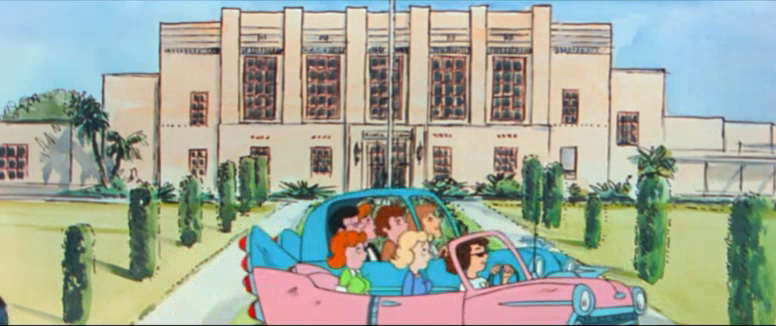 Grease (Randal Kleiser, USA 1978) |
The opening credits of Grease are a striking example of the perfect synergy between animated sequences and the soundtrack: the song that gives the film its title was composed by Barry Gibb of the Bee Gees (who had previously composed the music for John Travolta’s earlier hit, Saturday Night Fever) and performed by Frankie Valli of the Four Seasons. It is no coincidence that Valli and his group were at the height of their success in the early 1960s, and Grease indeed captures the atmosphere of the 1950s - a decade that, just two decades later, was already being revisited as legendary, with a nostalgic tone that glossed over the far from idyllic reality of that era ... This hilarious animated sequence draws on a whole series of elements that have now become part of the popular imagination - and which are hard to catch in their rapid succession: from hair “gel” to the hula hoop, from the slogan “I like Ike”- used by Eisenhower in his presidential campaigns - to images of Marilyn Monroe and James Dean, from posters for B-movies like She Gods of Shark Reef and blockbusters like The Ten Commandments to commercials for Firestone tires and Pepsi-Cola … and much, much more. |
|
|
||
| Come in Grease i crediti sono spesso incorniciati in manifesti pubblicitari ed inseriti quindi in un contesto urbano, anche in Mio zio essi sono presentati come scritte sui cartelli di un cantiere: ma in questo caso il contesto è realistico, con le immagini ed i rumori associati a questo luogo particolare, con il titolo originale del film (Mon oncle) scritto col gesso su un muro fatiscente, tra cani randagi che scodinzolano ... solo un'anticipazione del tono scanzonato di questa commedia tra il grottesco ed il surreale, dove colori, suoni, musiche, luci, movimenti dei personaggi danno vita ad una commedia che mette alla berlina molti valori dell'epoca, dall'efficienza "meccanica" alle architetture "moderniste" al consumismo emergente ... |
 Mio zio/Mon oncle/My uncle (Jacques Tati, France-Italy 1958) |
Just as in Grease the credits are often framed within advertising posters and thus set in an urban context, in My Uncle, too, they are presented as text on construction site signs: but in this case, the setting is realistic, with the images and sounds associated with this particular place, and the film’s original title (Mon oncle) written in chalk on a crumbling wall, amid wagging stray dogs ... just a preview of the lighthearted tone of this comedy, which straddles the line between the grotesque and the surreal, where colors, sounds, music, lighting, and the characters’ movements bring to life a comedy that pokes fun at many of the era’s values - from “mechanical” efficiency to “modernist” architecture to emerging consumerism ... |
| Niente di più
lontano da Mio zio sono i titoli di testa di Toro scatenato,
che introducono in pochi istanti la carriera, ma soprattutto la
drammatica vicenda umana, del pugile Jake LaMotta. Il tono crepuscolare
e l'atmosfera rarefatta di questa sequenza, in cui il pugile,
interpretato da Robert De Niro, si muove al rallentatore sul ring, è
suggellato dal lento pezzo orchestrale - l'"Intermezzo" dall'opera
Cavalleria Rusticana di Pietro Mascagni, anch'esso un rimando alle
origini italiane del protagonista. |
 Toro scatenato/Raging bull (Martin Scorsese, USA 1980) |
Nothing could be further from My Uncle than the opening credits of Raging Bull, which in just a few moments introduce the career - but above all, the dramatic life story - of boxer Jake LaMotta. The twilight tone and rarefied atmosphere of this sequence - in which the boxer, played by Robert De Niro, moves in slow motion in the ring -is underscored by the slow orchestral piece, the “Intermezzo” from Pietro Mascagni’s opera Cavalleria Rusticana, which also serves as a reference to the protagonist’s Italian origins.
|
|
Torniamo ad una coloratissima e divertente sequenza animata per i titoli di testa di Questo pazzo, pazzo, pazzo, pazzo mondo, che già nella reiterazione del titolo suggerisce il tono scanzonato e scatenato di questa commedia, tutta centrata sulle vicende di un gruppo di persone, casualmente coinvolte nella ricerca di un tesoro e sempre più nevroticamente portate ad inseguirsi per arrivare primi alla meta. Riprendendo le classiche tecniche delle comiche del cinema muto, il film offre nel contempo una galleria di mostruosità umane che troveranno nell'ironico finale un tocco di esilarante sovversione. Questa lunga sequenza (firmata da Saul Bass), che anticipa con ironia e leggerezza alcune delle scene del film, poteva risultare particolarmente efficace e coinvolgente se vista su grande schermo, approfittando del formato panoramico (Cinerama) con cui il film era stato girato (e la cui magia inevitabilmente si perde se vista su uno schermo più piccolo, o addrittura sullo schermo TV). |
 Questo pazzo, pazzo, pazzo, pazzo mondo/It's a mad, mad, mad, mad world (Stanley Kramer, USA 1963) |
Let’s return to a colorful and entertaining animated sequence for the opening credits of It's a mad, mad, mad, mad world, which, even in the repetition of the title, hints at the lighthearted and wild tone of this comedy - centered entirely on the adventures of a group of people who are accidentally drawn into a treasure hunt and become increasingly neurotically driven to chase one another in order to reach the finish line first. Drawing on classic silent-film comedy techniques, the film simultaneously presents a gallery of human monstrosities that find a touch of hilarious subversion in the ironic finale. This lengthy sequence (designed by Saul Bass), which previews some of the film’s scenes with irony and lightheartedness, could have been particularly effective and engaging when viewed on the big screen, taking full advantage of the panoramic (Cinerama) format in which the film was shot (and whose magic is inevitably lost when viewed on a smaller screen, such a TV screen). |
| Il tono crepuscolare dei titoli di testa di Butch Cassidy è magistralmente colto dai falsi filmati d'epoca proiettati come un film muto sulla sinistra dello schermo, accompagnati dalla musica sincopata di Burt Bacharach. Questi filmati, così falsi e nel contempo così evocativi, introducono il tono tutto sommato nostalgico (seppur tragicomico) del film, ritratto di due fuorilegge "fuori tempo massimo" (interpretati da due mostri sacri come Robert Redofrd e Paul Newman, mai così in sintonia). Il loro destino rocambolesco e alla fine tragico li rende allo stesso tempo simboli di quel ribellismo giovanile tipico degli anni '60 - destinato a fallire proprio come questi due ingenui eroi di un West ironicamente visitato, incapaci di inserirsi in un mondo ormai cambiato senza speranza. |
 Butch Cassidy/Butch Cassidy and the Sundance Kid (George Roy Hill, USA 1969) |
The twilight atmosphere of the opening credits of Butch Cassidy and the Sundance Kid is masterfully captured by the fake archival footage projected like a silent film on the left side of the screen, accompanied by Burt Bacharach’s syncopated music. These clips - so fake and yet so evocative - set the film’s ultimately nostalgic (albeit tragicomic) tone, portraying two outlaws “past their prime” (played by two legends, Robert Redford and Paul Newman, who were never more in sync). Their daring and ultimately tragic fate makes them symbols of the youthful rebellion typical of the 1960s - doomed to fail just like these two naive heroes of an ironically revisited Wild West, unable to fit into a world that has changed beyond hope. |
| Ancora Saul Bass firma i titoli di testa di Anatomia di un omicidio, teso dramma processuale basato su un ambiguo caso di omicidio, dove verità e realtà non coincidono mai e sono anzi destinate a confondersi sino alla fine. Questa sequenza animata coglie il tono del film nel proporre sin dall'inizio la sagoma di un corpo smembrato, i cui "pezzi" compaiono e scompaiono continuamente sullo schermo, senza mai ricomporsi, a simboleggiare l'inafferrabilità delle vicende umane. All'effetto spiazzante delle immagini contribuisce la (pluripremiata) colonna sonora, scritta da Duke Ellington e Billy Strayhorn. |
 Anatomia di un omicidio/Anatomy of a murder (Otto Preminger, USA 1959) |
Once again, Saul Bass designed the opening credits for Anatomy of a Murder, a tense courtroom drama based on an ambiguous murder case, where truth and reality never coincide and are, in fact, destined to remain intertwined until the very end. This animated sequence captures the film’s tone by presenting, right from the start, the silhouette of a dismembered body, whose “pieces” continuously appear and disappear on screen without ever coming back together, symbolizing the elusiveness of human affairs. The (multi-award-winning) soundtrack, composed by Duke Ellington and Billy Strayhorn, adds to the unsettling effect of the images. |
| Il sottotitolo della versione italiana diquesto film recita: Una "normale" famiglia di supereroi. Ed in effetti questo primo "fumetto" digitale del marchio Pixar con protagonisti esseri umani mette in scena una famiglia apparentemente "normale", ma in realtà composta da papà, mamma e tre figli che posseggono poteri sovrumani, che saranno chiamati ad utilizzare per salvare se stessi ma anche la loro stessa città. I titoli di testa anticipano le straordinarie scenografie, al limite dell'astratto, realizzate con una tecnologia sofisticata. Non solo un divertimento per famiglie, ma anche, più in profondità, una riflessione satirica sull'America di oggi, un mondo molto complesso che naviga tra la classica commedia hollywoodiana apparentemente tranquilla e paciosa e le avventure (ma anche le minacce) di un mondo tecnologico in cui dominano le apparenze e la superficialità dei nuovi media. |
 Gli incredibili/The incredibles (Brad Bird, USA 2004) |
The subtitle of the Italian version of this film reads: "A “normal” family of superheroes". And indeed, this first digital “comic” from Pixar - featuring human characters - depicts a seemingly “normal” family, but one that is actually made up of a dad, a mom, and three kids who possess superhuman powers, which they will be called upon to use to save not only themselves but also their city. The opening credits foreshadow the extraordinary, almost abstract sets, created using sophisticated technology. It is not just family entertainment, but also, on a deeper level, a satirical reflection on today’s America - a highly complex world that navigates between the classic, seemingly calm and peaceful Hollywood comedy and the adventures (but also the threats) of a technological world dominated by appearances and the superficiality of new media. |
| Ed è sempre
Saul Bass a disegnare i credits di Quando la moglie è in vacanza, dove lo schermo si riempie di forme geometriche
(quadrati, rettangoli) di vari colori, che si muovono, si aprono e
chiudono per visualizzare i titoli di testa, in sincronia con la ritmica
partitura musicale che rievoca il frizzante svolgimento degli eventi che
compongono la trama di questa commedia di fama mondiale, con
l'indimenticabile interpretazione di Marilyn Monroe. |
 Quando la moglie è in vacanza/The seven year itch (Billy Wilder, USA 1955) |
And it was Saul Bass who designed the opening credits for The Seven Year Itch, too, where the screen fills with geometric shapes (squares, rectangles) of various colours that move, open, and close to reveal the opening titles, in sync with the rhythmic musical score that evokes the lively unfolding of events making up the plot of this world-famous comedy, featuring Marilyn Monroe’s unforgettable performance.
|
| Il capolavoro di Stanley Kubrick adatta per lo schermo l'omonimo romanzo di Vladimir Nabokov, centrato sull'ossessione amorosa di un professore di mezza età (James Mason) per una ammiccante ninfetta adolescente (Sue Lyon), che lo condurrà in breve tempo alla rovina e alla morte. I titoli di testa colgono proprio il senso di questa morbosa infatuazione irrazionale: vediamo soltanto una mano che con grande cura e delicatezza applica lo smalto sulle unghie di un piede femminile ... Non sappiamo ancora a chi appartengano la mano e il piede, ma già siamo noi stessi irretiti in questa ambigua atmosfera, sottolineata dal motivo musicale al contempo lirico e drammatico composto da Nelson Riddle. |
 Lolita (Stanley Kubrick, USA-GB 1962) |
Stanley Kubrick’s masterpiece adapts Vladimir Nabokov’s novel of the same name for the screen, focusing on the amorous obsession of a middle-aged professor (James Mason) with a flirtatious teenage nymphet (Sue Lyon), which will soon lead him to ruin and death. The opening credits perfectly capture the essence of this morbid, irrational infatuation: we see only a hand carefully and delicately applying nail polish to the toenails of a woman’s foot… We do not yet know to whom the hand and foot belong, but we are already ensnared in this ambiguous atmosphere, underscored by the musical theme - at once lyrical and dramatic - composed by Nelson Riddle. |
| Il famosissimo film di Sergio Leone completa la cosiddetta "trilogia del dollaro" (dopo Per un pugno di dollari e Per qualche dollaro in più), ed evoca i temi centrali del western classico con un misto di animazioni, "pennellate" e "macchie" di colore (di sangue?) che "dipingono" lo schermo, e ritratti abbozzati dei personaggi principali. Ma questa introduzione non avrebbe il suo potente impatto senza la colonna sonora di Ennio Morricone, giustamente famosa almeno tanto quanto il film, e che mescola in modo sorprendente poche note, spari, fischi e quello che sembra l'ululato di un coyote. Morricone stesso spiegò: "Quando dirigo il pezzo in concerto, gli ululati di coyote che danno il ritmo ai titoli del film sono realizzati di solito col clarinetto, ma nella versione originale adottai soluzioni molto più inventive. Due voci maschili cantavano sovrapponendosi l'una con l'altra, una gridando A e l'altra E. Gli AAAH ed EEEH dovevano essere eloquenti, per imitare l'ululato dell'animale ed evocare la ferocia del selvaggio West." (Nota 1) |
 Il buono, il brutto, il cattivo/The good, the bad and the ugly (Sergio Leone, Italy 1966) |
Sergio Leone’s hugely famous film completes the so-called “Dollar Trilogy” (following A Fistful of Dollars and For a Few Dollars More), and evokes the central themes of the classic Western with a mix of animations, “brushstrokes,” and “splashes” of colour (blood?) that “paint” the screen, along with sketched portraits of the main characters. But this introduction would not have its powerful impact without Ennio Morricone’s score, which is just as famous as the film itself and surprisingly blends a few notes, gunshots, whistles, and what sounds like a coyote’s howl. Morricone himself explained: “When I conduct the piece in concert, the coyote howls that set the rhythm for the film’s opening credits are usually played on the clarinet, but in the original version I adopted much more inventive solutions. Two male voices sang in overlapping layers, one shouting ‘A’ and the other ‘E.’ The ‘AAAAH’ and ‘EEEH’ were meant to be expressive, to imitate the animal’s howl and evoke the ferocity of the Wild West.” (Note 1) |
| Un altro
geniale artista, Richard Williams, firma la sequenza animata di Ciao
Pussycat, best seller dall'estetica pop anni '60 interpretato da una
serie di celebrità (Peter Sellers, Peter O'Toole, Woody Allen, Romy
Schneider, Capucine, Paula Prentiss e Ursula Andress come "guest star")
e basato sulla prima sceneggiatura prodotta da Woody Allen. La vivace
sequenza animata presenta i personaggi principali e i corrispondenti
nomi degli attori/attrici, oltre a dettagli che prefigurano il tema del
film, all'interno di contesti altamente elaborati e pieni di colore ed
energia. Anche in questo caso, la colonna sonora, di Burt Bacharach,
gioca un ruolo importante: la canzone del titolo, cantata da Tom Jones,
fu nominata all'Oscar e divenne un successo internazionale. |
 Ciao Pussycat/What's new, Pussicat? (Clive Donner, USA 1965) |
Another brilliant artist, Richard Williams, created the animated sequence for What's new, Pussycat?, a best-selling film with a 1960s pop aesthetic featuring a cast of celebrities (Peter Sellers, Peter O'Toole, Woody Allen, Romy Schneider, Capucine, Paula Prentiss, and Ursula Andress as “guest star”) and based on the first screenplay produced by Woody Allen. The lively animated sequence presents the main characters and the corresponding names of actors/actresses, in addition to details foreshadowing the theme of the film, within highly elaborated contexts full of colour and energy. Again, the musical score, by Burt Bacharach, plays an important part: the title song, sung by Tom Jones, was Oscar-nominated and became an international hit. |
| Proprio gli anni '60 segnano il trionfo degli effetti speciali applicati alle
sequenze dei titoli, e Maurice Binder può essere giustamente ricordato
accanto a Saul Bass per il suo uso inventivo della grafica (in un
momento in cui gli effetti speciali digitali non erano ancora
disponibili). Binder è probabilmente meglio conosciuto per le sequenze
dei titoli che ha disegnato per i film di James Bond, incluso il primo,
Agente 007 - Licenza di uccidere. Sulle note del celebre "tema
di James Bond" composto da John Barry, "[Un] singolo punto bianco si
trasforma in un'animazione astratta di vari punti colorati ... [Poi] la musica
rallenta e sfuma in un ritmo di samba. Le immagini si trasformano quindi
in diverse sagome colorate di persone che ballano ... Dopo questa
sequenza, la musica cambia di nuovo in un ritmo diverso e anche le
immagini sullo schermo cambiano ... [sfumando] nei personaggi reali mentre il film vero
e proprio ha inizio. Questo metodo per sfumare i crediti nella storia
vera e propria è stato utilizzato più e più volte da Binder nei
successivi film di Bond." (Nota 2) |
 Agente 007 - Licenza di uccidere/Dr. No (Terence Young, GB 1962) |
The 1960s marked the triumph of special effects applied to title
sequences, and
Maurice Binder can rightly be remembered next to Saul Bass for his
inventive use of graphic design (at a time when digital special effects
were not yet available). Binder is probably best known for the title
sequences he designed for 16 James Bond films, including the first one,
Dr. No. To the theme of the well-known "James Bond theme"
written by John Barry, "[A]
single white dot transforms into an abstract
animation of various colored dots ... Then the music slows down and fades into a samba rhythm.
The visuals then turn into different colored silhouettes of people
dancing ... After this sequence, the music changes again to a different
rhythm and the images on the screen fade into the
actual characters in the film as the feature begins. This method of
fading the credits into the actual story was used time and again by
Binder in the future Bond releases." (Note 2)
|
| Lord of war racconta le vicende di un contrabbandiere ucraino-americano (Nicolas Cage), arricchitosi nel mercato globale trafficando in armi provenienti dall'ex-esercito dell'URSS. I titoli di testa ci propongono un viaggio attraverso il processo di fabbricazione delle pallottole, per poi spostarsi in un teatro di guerra dove vengono trasportate e distribuite ... finchè una di loro raggiunge il suo mortale obiettivo. Accompagnano queste immagini le note di un'iconica canzone del 1966, "For What It's Worth" del gruppo folk-rock Buffalo Springfield. |
 Lord of war (Andrew Niccol, USA-Germany 2005) |
Lord of War tells the story of a Ukrainian-American arms dealer (Nicolas Cage) who made his fortune on the global market by trafficking weapons from the former Soviet Army. The opening credits take us on a journey through the bullet-making process, before shifting to a war zone where the bullets are transported and distributed ... until one of them reaches its deadly target. These images are accompanied by the notes of an iconic 1966 song, “For What It’s Worth” by the folk-rock band Buffalo Springfield. |
| Il nome di Richard Williams è forse meglio ricordato per il suo lavoro sulla creazione di uno dei personaggi più noti della storia del cinema, la "Pantera Rosa" (che però in realtà si riferisce ad un prezioso diamante). Nel primo film della serie interpretata da Peter Sellers nei panni dell'Ispettore Clouseau, i titoli di testa introducono subito la "Pantera" come personaggio, che si muove e gesticola in sincronia con la celeberrima colonna sonora di Henry Mancini. La vediamo inseguita dall'ispettore, poi giocare con gli stessi titoli, anticipando anche alcune delle scene del film che sta per iniziare ... Il personaggio della Pantera Rosa è diventato così famoso che ha generato serie TV animate, videogiochi, oltre a un merchandising molto redditizio. |
 La pantera rosa/The pink panther (Blake Edwards, USA 1963) |
Richard Williams is perhaps best remembered for his work in creating one of the most famous characters in film history, the “Pink Panther” (which, in reality, refers to a precious diamond). In the first film of the series, starring Peter Sellers as Inspector Clouseau, the opening credits immediately introduce the “Panther” as a character, moving and gesturing in sync with Henry Mancini’s famous soundtrack. We see it being chased by the inspector, then playing with the opening credits themselves, even foreshadowing some of the scenes from the film that is about to begin... The Pink Panther character has become so famous that it has spawned animated TV series, video games, and a highly profitable line of merchandise. |
Note/Notes
1. Da/From Wikipedia.
2. An analysis of the opening credit sequence in film, by Melis Inceer, University of Pennsylvania Scholarly Commons website, pp. 34-35.